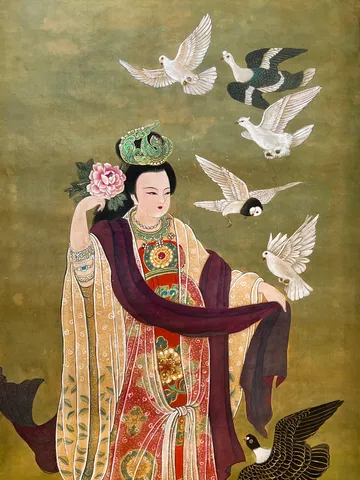
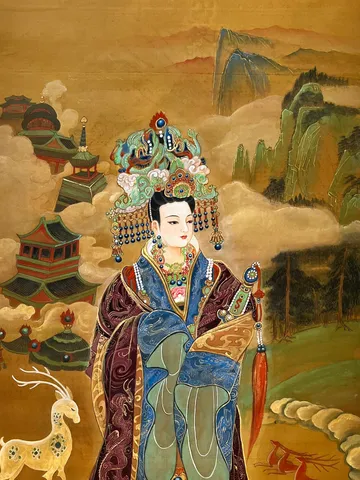
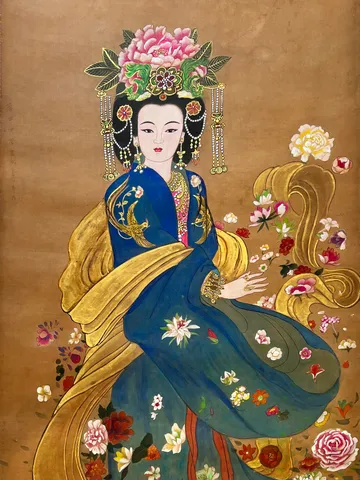
太穆皇后
了解李湘《中国皇后》系列中的太穆皇后,探索其历史背景及与中国历代宫廷女性的联系。
窦氏 · 太穆皇后
“Chosen at the Peacock Screen”
Her father made her suitors shoot at a painted screen; the man who put an arrow through each peacock’s eye founded the Tang. She died five years before the dynasty existed, and produced the emperor who defined it and the only woman in Chinese history buried with military honours.
Her Story
She died five years before the Tang existed, and she is the reason it did.
Her mother was a princess of the Northern Zhou and her uncle was its emperor, who liked her enough to raise her in the palace. The first thing anyone recorded her saying was said there, when she was about six.
Her uncle had made a political marriage to a Turkic princess and made no effort to hide his indifference to her. The child pulled him aside and told him that the northern frontier was not yet secure, that the Turks were strong, and that if he would only treat his wife with affection the whole empire would be easier to govern. He is said to have taken the advice.
Ten years later the Northern Zhou fell. Yang Jian, the regent, took the throne and began killing her uncle’s family. She threw herself face-down on a couch and wept that her only regret was not having been born a man, so that she might have saved them.
My only regret is that I was not born a man, so that I might have saved my uncle’s house.
Lady Dou, aged about sixteen, on the fall of the Northern Zhou — Jiu Tang Shu, ch. 51
He also decided she was too good to marry off casually. So he set a competition: two peacocks painted on a screen, and each suitor given two arrows. Dozens tried. Li Yuan put one arrow through each bird’s eye, and got her.
The Chinese language still carries that afternoon. To be chosen at the peacock screen — 雀屏中選 — remains the phrase for winning a contest for someone’s hand.
They were married for roughly twenty-five years, and she was plainly the sharper of the two. When Li Yuan was serving the Sui and came into possession of some exceptional horses, she told him to send them to Emperor Yang immediately, because the emperor was greedy and suspicious and would hear about them anyway. Li Yuan kept the horses. He was demoted. Some time later he sent them, and was promoted, and told his sons that he wished he had listened to their mother.
She bore him four sons and at least one daughter, and the family she produced is close to unbelievable. Li Shimin became Emperor Taizong and the most admired ruler in Chinese history. Princess Pingyang raised an army of seventy thousand in her own right during the rebellion, held the passes west of the capital, and is the only woman in Chinese history buried with full military honours — drums and horns at her funeral, over the objection of the officials, because her father said she had been no ordinary woman.
And two of her sons killed each other, or nearly — Li Shimin ambushed Li Jiancheng and Li Yuanji at the Xuanwu Gate in 626 and had them and their ten sons killed.
She did not see any of it. She died in 613, aged about forty-five, four years before her husband declared for the rebellion and five before he took the throne. He honoured her as empress immediately on his accession, and never appointed another.
When her son Taizong was emperor he is recorded saying that if his mother had lived, his father would have listened to her, and things would have gone differently between the brothers.
A note on the sources
Her biography was written after her son became the model emperor of Chinese history, and the childhood anecdotes have the shape of stories told backwards from a known ending — the precocious political advice at six, the wish to have been born a man. The peacock screen is likewise too neat to be safe. What is solid is the marriage, the children, the date of her death, and her husband’s decision never to appoint another empress in the eight years he reigned after it.
- Liu Xu et al., Jiu Tang Shu (Old Book of Tang), ch. 51 — 945 CE
- Ouyang Xiu et al., Xin Tang Shu (New Book of Tang), ch. 76 — 1060
- Sima Guang, Zizhi Tongjian, ch. 184–191 — 1084
The Emperor
Emperor Gaozu of Tang 唐高祖
Li Yuan 李渊 · 566 – 635 · reigned 618 – 626
A Sui general and hereditary duke from the north-western military aristocracy, who was pushed into rebellion in 617 partly by his own sons and took Chang’an within months. He founded the dynasty that ran China for the next three centuries.
He is consistently underrated, because the histories were written under the son who overthrew him. The land-equalisation system, the currency, the administrative divisions and the first version of the Tang legal code are all his.
What he could not do was choose between his children. He kept Li Jiancheng as heir and Li Shimin as his best general, let them build rival establishments, and in 626 the two of them settled it at the Xuanwu Gate. He abdicated two months later and lived another nine years in retirement.
See also: Emperor Gaozu.
Connections
- Her daughter-in-law Empress Zhangsun — married to Li Shimin, and present at the Xuanwu Gate the morning it was decided.
- Her grandson’s empress Empress Wang — from the same aristocratic world, and destroyed by a woman from outside it.
- What came next Wu Zetian — a timber merchant’s daughter, and the end of the north-western families’ hold on the throne.
- The dynasty before The Sui empresses — the house her husband served, and overthrew.
About this Portrait
| Artist | Xiang Li 李湘 |
| Medium | Chinese watercolor on silk, hand-painted on hand-cut silk |
| Dimensions | approx. 36 × 72 inches (91 × 183 cm) |
| Painted | 2012 |
| Subject | Empress Taimu, consort of Emperor Gaozu |
| Collection | The Chinese Empresses Collection |
| Availability | Original held by the artist · Prints available |