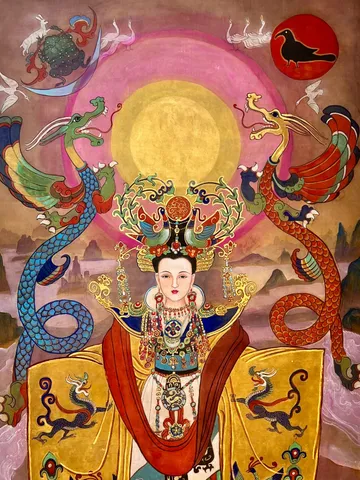
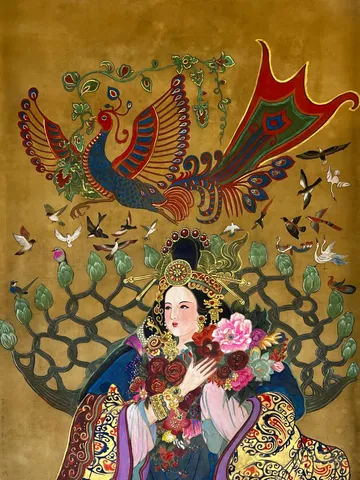
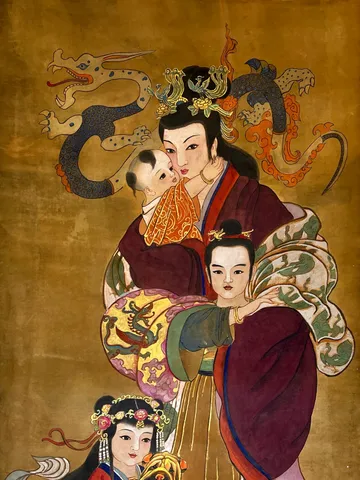
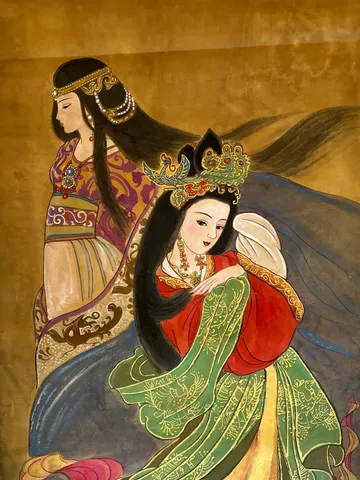
陈娇皇后与卫子夫皇后
了解李湘《中国皇后》系列中的陈娇皇后与卫子夫皇后,探索其历史背景及与中国历代宫廷女性的联系。
陳嬌 · 衛子夫
“The Golden House and the Singer”
Emperor Wu’s two empresses. One was promised a house of gold when they were children and died alone in a cold palace. The other was a household singer who ruled beside him for thirty-eight years and then killed herself.
Their Story
Chen Jiao was promised a golden house before either of them was old enough to marry.
She was the daughter of Princess Liu Piao, Emperor Jing’s formidable elder sister, and the story goes that when Liu Che was a small boy his aunt sat him on her knee and asked whether he would like her daughter Ah Jiao for a wife. He said that if he had Ah Jiao he would build her a house of gold to live in. The phrase entered the language — 金屋藏嬌, “to keep Ah Jiao in a golden house” — and it has meant a lavishly kept woman ever since, usually with an edge of warning in it.
The betrothal was the alliance that made him emperor. Princess Liu Piao spent years turning her brother against the existing crown prince, and in exchange Liu Che got the throne and Chen Jiao got the empress’s title in 141 BCE.
She could not have children. Enormous sums were spent on physicians and none of it worked, and she watched her husband’s attention move elsewhere. In 130 BCE it emerged that she had employed sorceresses — to win him back, and to curse the woman who had replaced her. Witchcraft in the palace was a capital matter. She was deposed and sent to the Changmen Palace, and she lived there another decade or so with the rank of a commoner.
Tradition holds that she paid the poet Sima Xiangru a great sum to write a rhapsody about her loneliness in the hope it would reach the emperor and move him. The Rhapsody of Changmen exists; the story of its commission may not be true. It did not work either way.
Wei Zifu was the woman she had tried to curse, and she had started as a singer.
She belonged to the household of Princess Pingyang, the emperor’s sister, who kept attractive young women on hand for exactly the purpose they served. When Wu visited in 139 BCE, Wei Zifu sang; he noticed her; and she went with him to the changing room. She left the household that day.
Her rise was slow and then total. She bore him three daughters, and in 128 BCE she bore his first son, Liu Ju. She was made empress that year and held the position for thirty-eight — longer than any empress of the Han except one.
What came with her mattered more than she did. Her half-brother Wei Qing had been a stable hand; he became the general who broke the Xiongnu in the field and drove them out of the Ordos. Her nephew Huo Qubing became the most brilliant cavalry commander China had yet produced and was dead at twenty-three. The Han’s expansion northwest, the opening of the Silk Road, the empire at its greatest extent — all of it ran through her family.
Then in 91 BCE the same accusation that had destroyed Chen Jiao destroyed her. The emperor, old and ill and increasingly frightened, authorised an investigator named Jiang Chong to hunt for witchcraft in the palace. Jiang Chong planted evidence in the crown prince’s residence. Liu Ju, unable to reach his father and certain he was about to be executed, raised troops and killed Jiang Chong. It was read as rebellion. Five days of fighting in the capital left tens of thousands dead. Liu Ju fled and hanged himself. Wei Zifu, ordered to surrender her seal, killed herself instead.
Emperor Wu worked out afterwards that almost none of it had been real. He built a palace called the Terrace of Longing for a Son, and issued an edict of repentance for the wars and the waste of his reign — the only Chinese emperor ever to do such a thing. It came too late for everyone concerned.
The two women are the same story told twice, and it is a story about witchcraft accusations in a court where the emperor’s affection was the only real currency. Chen Jiao used sorcery to try to hold a husband and lost everything. Wei Zifu never used it at all, and lost everything anyway.
A note on the sources
Sima Qian, who tells much of this, served at Emperor Wu’s court and was castrated on his orders for defending a general accused of surrender. He wrote his history afterwards. His portraits of Wu’s household are not neutral, and were never meant to be.
- Sima Qian, Shiji (Records of the Grand Historian), ch. 49 — c. 94–91 BCE
- Ban Gu, Hanshu (Book of Han), ch. 97 — c. 111 CE
- Sima Guang, Zizhi Tongjian — 1084
- Sima Xiangru (attrib.), Rhapsody of Changmen 長門賦
The Emperor
Emperor Wu of Han 漢武帝
Born Liu Che 劉徹 · 156 – 87 BCE · reigned 141 – 87 BCE
The longest-reigning emperor of the Han and the one who made it an empire: he broke the Xiongnu, opened the Silk Road, annexed territory from Korea to Vietnam, and installed Confucianism as the state ideology — the settlement that governed China until the twentieth century. He could not do any of it while his grandmother Empress Dou was alive, and began the year she died.
Why he matters to their story: both women held everything at his pleasure and lost it to the same charge. He deposed the first for witchcraft and drove the second to suicide over witchcraft that had been fabricated — then admitted, publicly and far too late, that he had been wrong.
Connections
- Chen Jiao’s motherPrincess Liu Piao — engineered the alliance that made Wu emperor, and her daughter empress.
- His mother Empress Wang Zhi — accepted the betrothal to Chen Jiao that won her son the throne.
- His grandmother Empress Dou — Grand Empress Dowager, and the block on his reign until 135 BCE.
- Successor Empress Shangguan — empress to Wu’s youngest son, and installed as a child in the settlement that followed the disaster of 91 BCE.
About this Portrait
| Artist | Xiang Li 李湘 |
| Medium | Chinese watercolor on silk, hand-painted on hand-cut silk |
| Dimensions | 36 × 72 inches (91 × 183 cm) |
| Painted | 2012 |
| Subjects | Two empresses — both consorts of Emperor Wu |
| Collection | The Chinese Empresses Collection |
| Availability | Original held by the artist · Prints available |