马皇后(明德皇后)
马皇后(明德皇后):浏览李湘艺术网站的中国历代皇后资料。本页正文暂为英文,完整译文待补充。
马皇后 · 明德皇后
“The One Who Refused”
Daughter of a general who died in disgrace, and the only empress in Chinese history who held the highest position available to a woman for nineteen years and never once used it to restore her own family’s name.
Her Story
Her father conquered Vietnam and died in disgrace.
Ma Yuan was one of the great generals of the restored Han — the man who put down the Trưng sisters’ rebellion in the far south and who is still quoted for saying a soldier should die on the battlefield and be carried home wrapped in horsehide. In 49 CE he took an army against the Wuling tribes and died there of plague, along with much of his force.
Then two men with grudges wrote to the emperor. His deputy Geng Shu, who had opposed his route, and Liang Song, the emperor’s son-in-law, accused him of causing the epidemic and of looting pearls and rhinoceros horn. Guangwu believed them. Ma Yuan was posthumously stripped of his marquisate and his fief, and his family lost everything it lived on.
His daughter was about ten. The noble family she was engaged to — the Dous — decided she was no longer worth marrying. Her mother and her cousin, insulted, broke the engagement themselves and offered her instead to the crown prince.
It was an act of wounded pride that produced the most admired empress in Chinese history.
At court, Consort Ma did everything the disgraced daughter of a ruined house had to do. She served her mother-in-law, Yin Lihua, so attentively that she became her favourite. She was warm to the other consorts rather than competitive with them. Childless herself, she went looking for beautiful women to bring to the crown prince’s bed, because he had too few sons — a fact the histories record admiringly and which reads today as something closer to strategy.
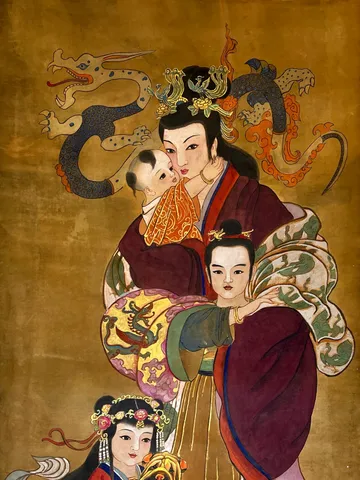
When her own elder sister’s daughter, Consort Jia, bore a son, the crown prince told Consort Ma to raise him as hers. She did it so completely that Liu Da never in his life regarded anyone else as his mother.
She became empress in 60 CE and immediately stopped behaving like one. She wore undyed silk without patterns. The princesses came to see her and were embarrassed to find her plainer than they were. Emperor Ming, who could not always decide things quickly, took to putting problems to her; she would work through them and give him an answer, and then — once he began asking about everything — she stopped, and told him his own judgement was sound. In 71, when a treason case against his brother had metastasised into mass torture and execution of anyone remotely connected to it, she intervened, and the purge stopped.
And in all fifteen years, she never once asked for anything for her family.
This is the part everyone remembers, and it is worth being precise about what it cost. Her father had died stripped of his titles. Restoring the Ma name was the one thing owed to her. She held the second-highest position in the empire for nineteen years and never took it.
When her son became Emperor Zhang and wanted to make his three uncles marquesses, she refused. He raised it again in 77 and she issued an edict — an empress dowager, publicly overruling an emperor on the subject of her own brothers. She wrote that she had passed the Zhuolong Gate and seen her family’s people coming to ask after her health, and that their carriages ran like flowing water and their horses like dragons. She ordered provincial officials to stop accepting requests from the Mas, and said that any relative living extravagantly would have his name struck from the noble rolls.
I passed the Zhuolong Gate and saw my family’s people coming to ask after me. Their carriages ran like flowing water, their horses like dragons.
Empress Dowager Ma, edict of 77 CE, refusing marquisates for her brothers — Hou Hanshu, ch. 10
She had reasons beyond modesty. She had watched what consort clans did to dynasties, and she had grown up inside the wreckage of what a court could do to a family that got too visible.
She spent her remaining years running a silk workshop and a mulberry garden that became a real source of income for the palace, teaching the Analects to her grandsons, and compiling the daily record of Emperor Ming’s reign — the first work of history in China written by a woman.
In 79 CE, Emperor Zhang enfeoffed his uncles anyway, over her objection. Under her pressure the new marquesses tried to decline; when he refused to let them, they resigned their government posts instead. She died that August, in her forties, and was buried with her husband.
Within twenty years the Eastern Han court was being run by consort clans — the Dous, then the Dengs, then the Yans, then the Liangs, each installing child emperors and each destroyed in turn. Every empress who follows on these pages is living in the system Ma Mingde tried to hold shut with one edict and a plain silk robe.
A note on the sources
Ma Mingde is the empress the Confucian historians wanted, so her biography should be read with that in mind — every detail in it also serves as a lesson. But the edict of 77 CE survives in her own words, and her refusal is corroborated by the plain administrative fact that her brothers held no fiefs until the year she died.
- Fan Ye, Hou Hanshu (Book of the Later Han), ch. 10 pt. 1 and ch. 24 — 5th century CE
- Sima Guang, Zizhi Tongjian, ch. 44–46 — 1084
- Her own Records of the Daily Life of Emperor Xianzong 显宗起居注 — now lost, but quoted by later historians
The Emperor
Emperor Ming of Han 汉明帝
Born Liu Zhuang 刘庄 · 28 – 75 CE · reigned 57 – 75 CE
Son of Yin Lihua and Emperor Guangwu, and one of the more capable rulers of the dynasty. He managed the Yellow River flood works, reopened the Silk Road by sending Ban Chao into the Western Regions, and is traditionally credited with introducing Buddhism to China — the White Horse Temple at Luoyang, founded in his reign, is the oldest in the country.
He was also severe. The treason case against his brother Liu Ying, Prince of Chu, spread into thousands of arrests and deaths before Empress Ma persuaded him to stop.
Why he matters to her story: he consulted her on government, which was unusual, and he never enfeoffed her brothers, which was what she asked for. Her restraint only worked because he accepted it.
Connections
- Her mother-in-law Empress Guanglie (Yin Lihua) — who had also refused honours for her own family, and whose favourite she became. The precedent Ma Mingde was following.
- Her son’s empress Empress Dou (Zhangde) — who did the exact opposite, and whose clan seized the government within a decade of Ma’s death.
- Her adoptive son’s successors Empress Yin and Deng Sui — the next generation, and the beginning of the child-emperor regencies.
- The counter-example Empress Lü Zhi — whose clan took everything it could reach, and was annihilated for it within months of her death.
About this Portrait
| Artist | Xiang Li 李湘 |
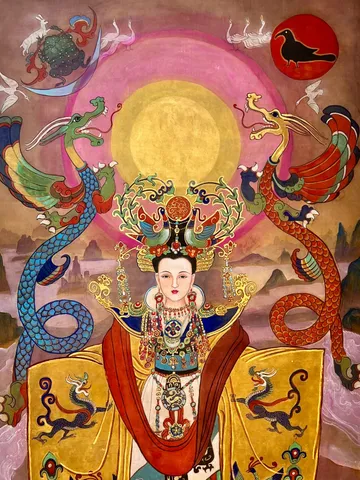
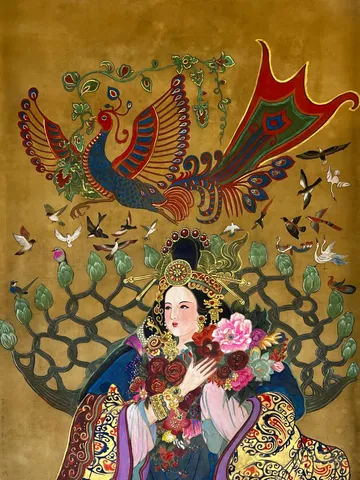
| Medium | Chinese watercolor on silk, hand-painted on hand-cut silk |
| Dimensions | approx. 36 × 72 inches (91 × 183 cm) |
| Painted | 2013 |
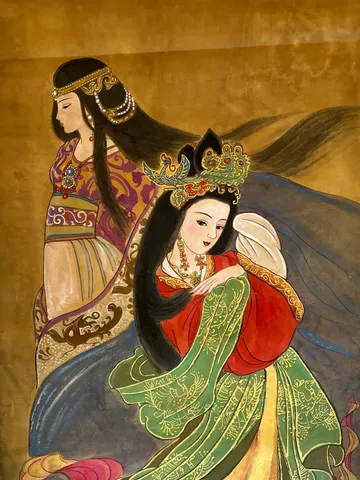
| Subject | Empress Ma, consort of Emperor Ming |
| Collection | The Chinese Empresses Collection |
| Availability | Original held by the artist · Prints available |