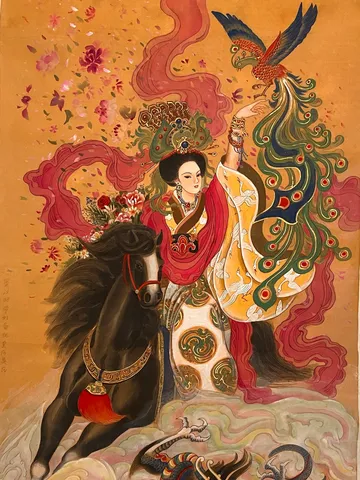
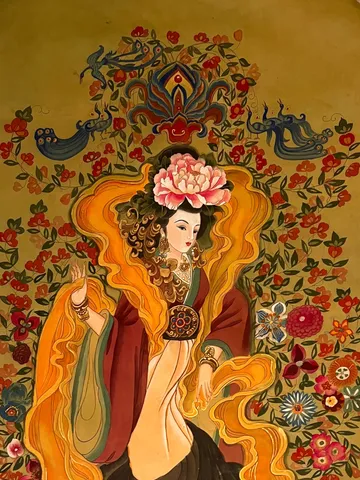
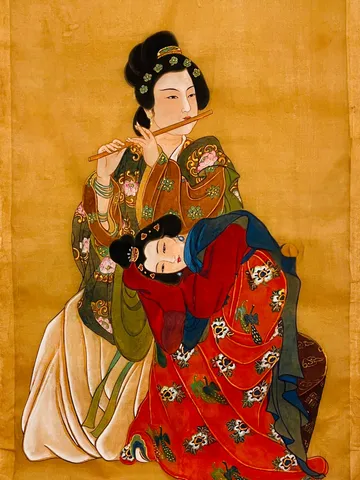
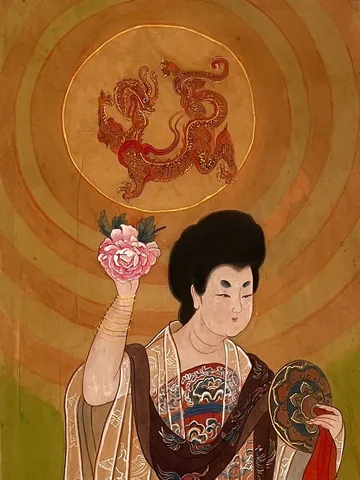
李皇后(后晋)
了解李湘《中国皇后》系列中的李皇后(后晋),探索其历史背景及与中国历代宫廷女性的联系。
李皇后 · 后晋
“The Sixteen Prefectures”
Her husband bought a throne from the Khitan by calling their khan his father and handing over every mountain pass on the northern frontier. China did not get that ground back for four hundred and thirty-three years. She ended her life farming a plot in Manchuria.
Her Story
She was an emperor’s daughter, married to one of her father’s generals. In 936 that general rebelled against her brother, and to win he made a bargain that shaped the next four hundred years of Chinese history.
Shi Jingtang could not beat the Later Tang alone, so he wrote to the Khitan. The terms he offered were extraordinary: he would call their emperor father — though he was eleven years the elder — pay an annual tribute of three hundred thousand bolts of silk, and cede the Sixteen Prefectures, the belt of territory containing every mountain pass across the northern frontier, including the ground where Beijing now stands.
The Khitan cavalry came south. Her brother’s dynasty fell. Her husband was made emperor of the Later Jin by a foreign khan who addressed him as son.
China did not get that territory back for four hundred and thirty-three years. Without the passes there was no northern defence line, and every subsequent dynasty — the Song most of all — spent its existence trying and failing to fight its way back to a wall it no longer held. The Song never managed it. It took the Ming, in 1368.
He served the Khitan as a father, though he was eleven years the elder, and gave away the sixteen prefectures. Later generations have not ceased to despise him for it.
On Shi Jingtang — Xin Wudai Shi, ch. 8
Her own position in this is not recorded as a matter of opinion. She was made empress in 936, and when her husband died in 942 she became empress dowager under his nephew.
The nephew was the one who broke it. Advised by a hawkish minister, he informed the Khitan court that he would be their grandson but not their subject — dropping the vassalage while keeping the family fiction.
The Khitan invaded. In 947 they took Kaifeng, ended the Later Jin, and carried the imperial family north.
She went with them. The deportation of the Later Jin court is one of the bleak set-pieces of the period: the emperor, the empress dowager, the consorts and the children walked to Liaodong under escort, given a plot of land at Huanglong Prefecture and told to farm it.
She died there. The sources do not record the year.
It is worth stating plainly what this page is: an empress of China, born an emperor’s daughter, who ended her life as an agricultural labourer in Manchuria because of a treaty her husband signed to get a throne he held for six years.
A note on the sources
Shi Jingtang is the most reviled figure in Chinese history after Qin Hui, and the Song historians writing about him were living with the consequences — the Northern Song spent its entire existence unable to defend a frontier he had given away, and was eventually destroyed through it. Their hostility is total and, in this instance, roughly proportionate.
Empress Li herself gets a few lines. Her deportation is recorded in the Old History of the Five Dynasties and in the Liao histories, which is how we know where the Later Jin court ended up.
- Xue Juzheng et al., Jiu Wudai Shi (Old History of the Five Dynasties), ch. 86 — 974
- Ouyang Xiu, Xin Wudai Shi (New History of the Five Dynasties), ch. 8 and 17 — c. 1073
- Tuotuo et al., Liao Shi (History of Liao) — 1344
- Sima Guang, Zizhi Tongjian, ch. 280–286 — 1084
The Emperor
Emperor Gaozu of Later Jin 后晋高祖
Shi Jingtang 石敬瑭 · 892 – 942 · reigned 936 – 942
A Shatuo Turkic general who married an emperor’s daughter, served the Later Tang competently for twenty years, and then — facing transfer to a lesser command, which he read correctly as a prelude to being destroyed — rebelled.
His bargain with the Khitan is the single most consequential territorial decision in the imperial period. The Sixteen Prefectures gave the steppe powers unrestricted access to the north China plain, and the Song’s permanent military weakness follows directly from not having them.
He is known in Chinese as the er huangdi — the son-emperor. He reigned six years, spent most of them apologising to Khitan envoys, and died at fifty.
The dynasty outlived him by five years.
Connections
- Her brother’s dynasty Empress Liu (Later Tang) — the house her husband destroyed with Khitan cavalry.
- Who came next Empress Li (Later Han) — a different Li, whose husband picked up the throne after the Khitan withdrew.
- What it cost The Song empresses — the dynasty that spent three centuries trying to recover what was given away here.
About this Portrait
| Artist | Xiang Li 李湘 |
| Medium | Chinese watercolor on silk, hand-painted on hand-cut silk |
| Dimensions | approx. 36 × 72 inches (91 × 183 cm) |
| Painted | 2020 |
| Subject | Empress Li, consort of Emperor Gaozu of Later Jin |
| Collection | The Chinese Empresses Collection |
| Availability | Original held by the artist · Prints available |