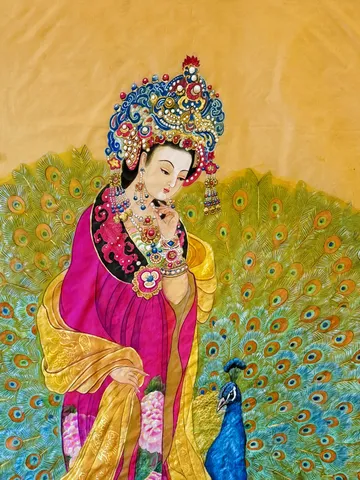
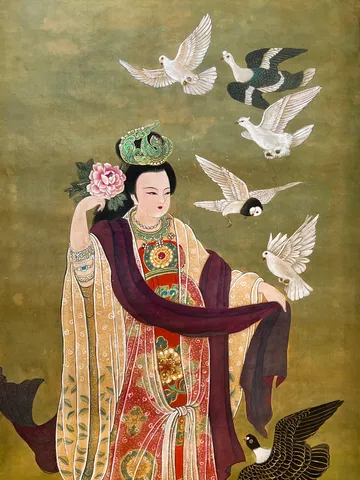
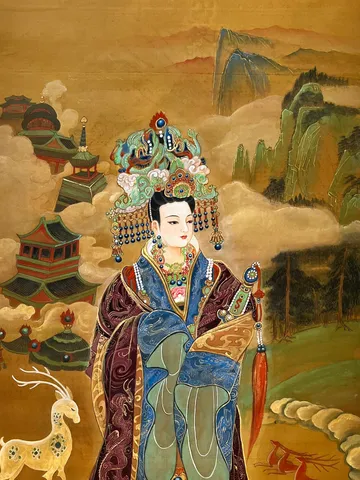
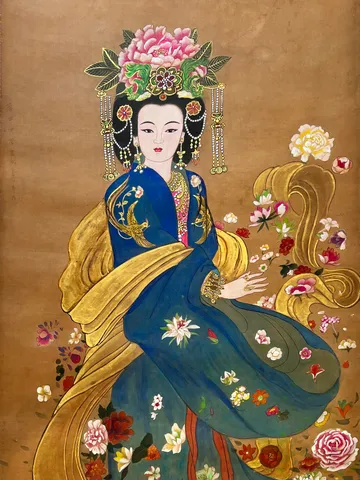
Empress Wang (Gaozong)
王皇后
“She Opened the Door”
The best-connected woman in China, losing ground to a rival with a son. So she brought a nun back from a temple to use against her — and the nun was Wu Zetian.
Her Story
She came from the Taiyuan Wang, one of the handful of northern aristocratic houses that had supplied consorts to emperors for three hundred years, and she was a great-niece of the founding emperor’s sister. There was no better-connected woman in China. She married Li Zhi while he was still Prince of Jin, and when he took the throne in 649 she became empress the following year.
She had no children. That was the whole of her problem, and it was not a small one.
Gaozong’s favourite was Consort Xiao, who had borne him a son and two daughters and made no secret of what that meant. Empress Wang was being edged out by a woman with an heir and the emperor’s attention, and she needed a counterweight.
So she found one. There was a former consort of the late emperor living as a nun at the Ganye Temple, whom Gaozong had noticed years earlier — an awkward, faintly scandalous connection that nobody at court wanted to revisit. Empress Wang revisited it. She personally arranged for Wu Zhao to be brought back into the palace, and reportedly encouraged her to grow her hair out for it.
It worked exactly as designed. Consort Xiao lost her position within two years.
And then it kept working.
By 654 the empress and the consort who had been enemies were allies, because they had the same problem now, and it was winning. In that year Wu’s infant daughter died shortly after Empress Wang had visited the nursery. Wu accused her of smothering the child. Whether that is true — whether the child was even murdered — is the oldest unresolved argument in Tang history, and the accusation appears in full only four hundred years later in Sima Guang. What is not in doubt is that Gaozong believed it.
The formal charge, when it came in 655, was witchcraft: the empress’s mother had brought a sorceress into the palace. Both women were stripped of rank, reduced to commoners, and imprisoned in a sealed courtyard with a single hole cut in the wall for food to be passed through.
Gaozong went to see them. He heard them through the wall, was moved, and called out that he would have them released.
He did not manage it.
When Wu learned of the visit she had both women given a hundred strokes, then their hands and feet cut off, and their bodies put into a vat of wine — where, the Old Book of Tang records her saying, these two witches could be steeped to the bone.
May I be reborn a cat and she a mouse, so that I may take her by the throat.
Consort Xiao, imprisoned with Empress Wang, 655 CE — Jiu Tang Shu, ch. 51
Cats were banned from the imperial palace afterwards. Wu was reported to be troubled by dreams of both women for years, and eventually moved the court permanently to Luoyang. She never lived in that palace again.
Empress Wang’s surname was posthumously changed to Mang — a poisonous vine — so that even the family name would carry the verdict. Her clan was exiled to the far south.
Fifty years later, after Wu Zetian was gone, both women’s families were rehabilitated and their names restored.
A note on the sources
The wine-vat account is in the Old Book of Tang, compiled in 945, and it is worth noticing that it is the same punishment attributed to Empress Lü eight centuries earlier. Chinese historians had an established vocabulary for a woman who took power, and the human swine was part of it. That does not make it false — but the echo should be heard.
The murdered-daughter accusation is weaker still. Neither Tang history states that Wu killed the child; the Zizhi Tongjian does, in 1084. Modern scholarship is broadly sceptical, and infant mortality in the seventh-century palace needed no explanation.
- Liu Xu et al., Jiu Tang Shu (Old Book of Tang), ch. 51 — 945 CE
- Ouyang Xiu et al., Xin Tang Shu (New Book of Tang), ch. 76 — 1060
- Sima Guang, Zizhi Tongjian, ch. 199–200 — 1084
- N. Harry Rothschild, Wu Zhao: China’s Only Woman Emperor — Pearson, 2008
The Emperor
Emperor Gaozong of Tang 唐高宗
Li Zhi 李治 · 628 – 683 · reigned 649 – 683
He inherited an empire at the height of its confidence and did rather well with it — the Tang reached its greatest ever extent under him, and the legal code issued in his name became the template for the law of Japan, Korea and Vietnam for a thousand years.
He was also, on the evidence of this page, a man who could be talked into anything by whoever had spoken to him most recently. He deposed the empress his father’s ministers had chosen for him, over the open opposition of his uncle and the entire aristocratic establishment, on a witchcraft charge nobody believed. Then he went to the cell, promised the two women their freedom, and did not deliver it.
From about 660 the strokes began, and the government passed to the woman he had put in their place.
See also: Emperor Gaozong.
Connections
- The woman she brought back Wu Zetian — recalled from the Ganye Temple on Empress Wang’s initiative, and empress in her place within four years.
- Her fellow prisonerConsort Xiao — the rival she had recruited Wu Zhao to displace, and who died beside her in 655.
- Her mother-in-law Empress Zhangsun — who had warned her own husband that consort clans destroy dynasties, and was dead nineteen years before this.
- The precedent Empress Lü Zhi — whose treatment of Consort Qi the Tang historians were consciously invoking.
About this Portrait
| Artist | Xiang Li 李湘 |
| Medium | Chinese watercolor on silk, hand-painted on hand-cut silk |
| Dimensions | approx. 36 × 72 inches (91 × 183 cm) |
| Painted | 2013 |
| Subject | Empress Wang, first consort of Emperor Gaozong |
| Collection | The Chinese Empresses Collection |
| Availability | Original held by the artist · Prints available |