Four Hundred and Thirteen Faces, One Family: A Review of Xiang Li’s Dream of the Red Chamber Coffee Table Book
October 21, 2026 · Tripti Gore Chandorkar · 15 min read
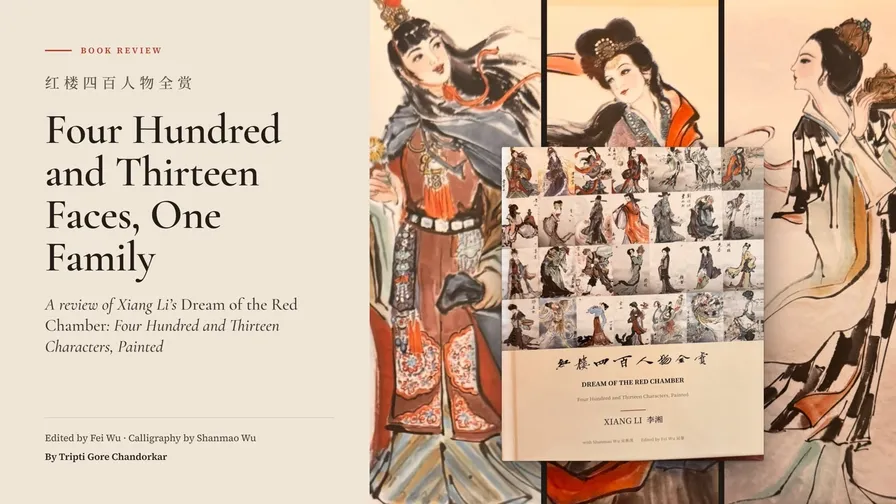
Some books are meant to be read. Others are meant to be lived with. You leave them open on a coffee table, come back to them on a quiet Sunday morning, and turn the pages slowly until the people inside start to feel like old acquaintances. Dream of the Red Chamber: Four Hundred and Thirteen Characters, Painted is the second kind.
Regular readers of this blog know I have written about Xiang Li’s Dream of the Red Chamber paintings twice before. The first post was about the collection itself, the first complete set of paintings of the novel’s characters. The second was about her extraordinary scroll of goddesses, which I was lucky enough to see unrolled in person. Both times I was writing about work that very few people will ever stand in front of. The character paintings now belong to a museum collection in Qingdao, China, and the scroll rests, rolled, in the artist’s home.
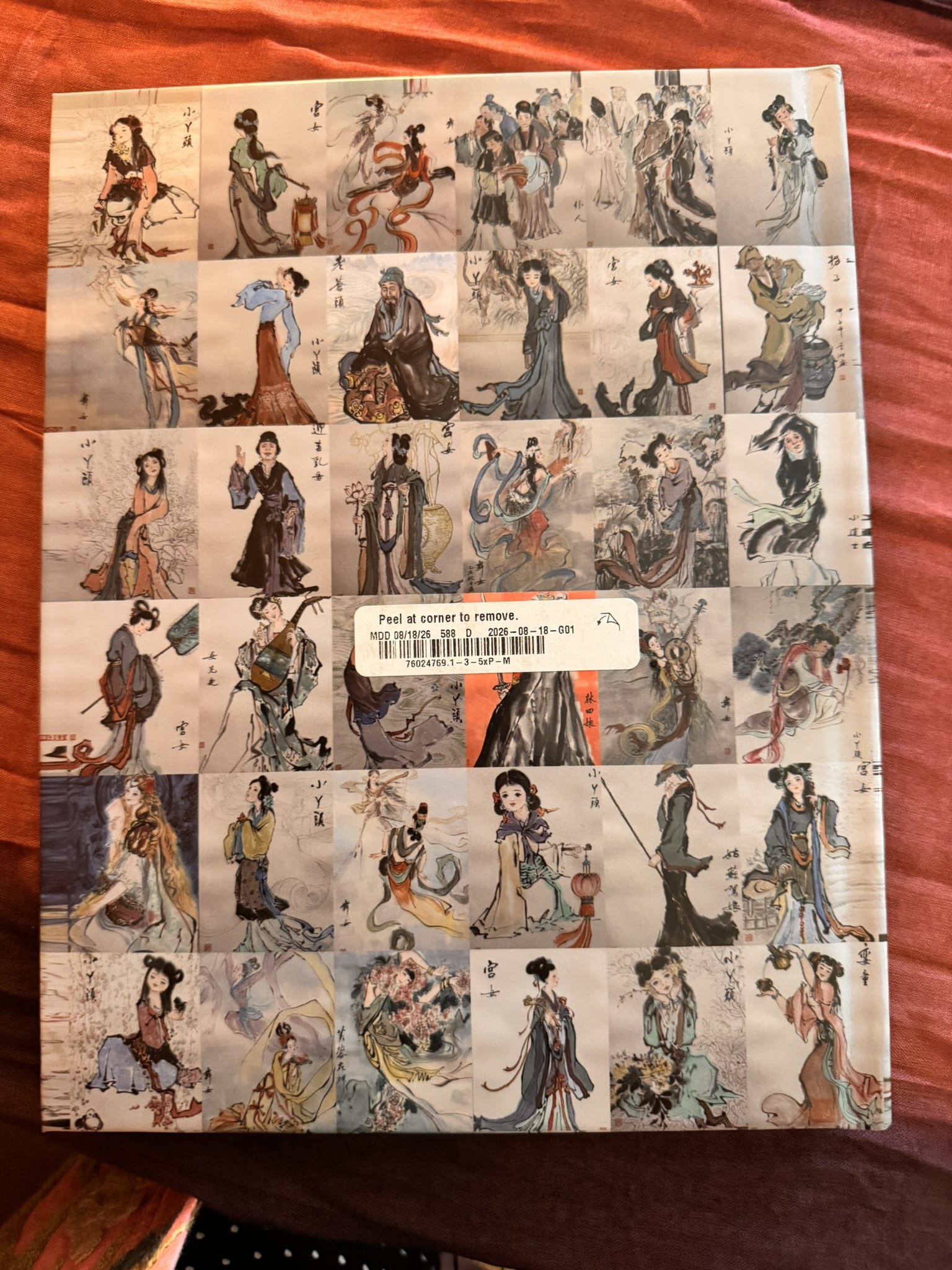
So when my copy of this book arrived, I sat with it for a long while before I opened it. It is a generous hardcover: 10 × 12 inches, 264 full-color pages, with a wall of portraits wrapping both covers. Edited by the artist’s daughter, Fei Wu, it brings the whole cast together in one place and prints it in full for the first time.
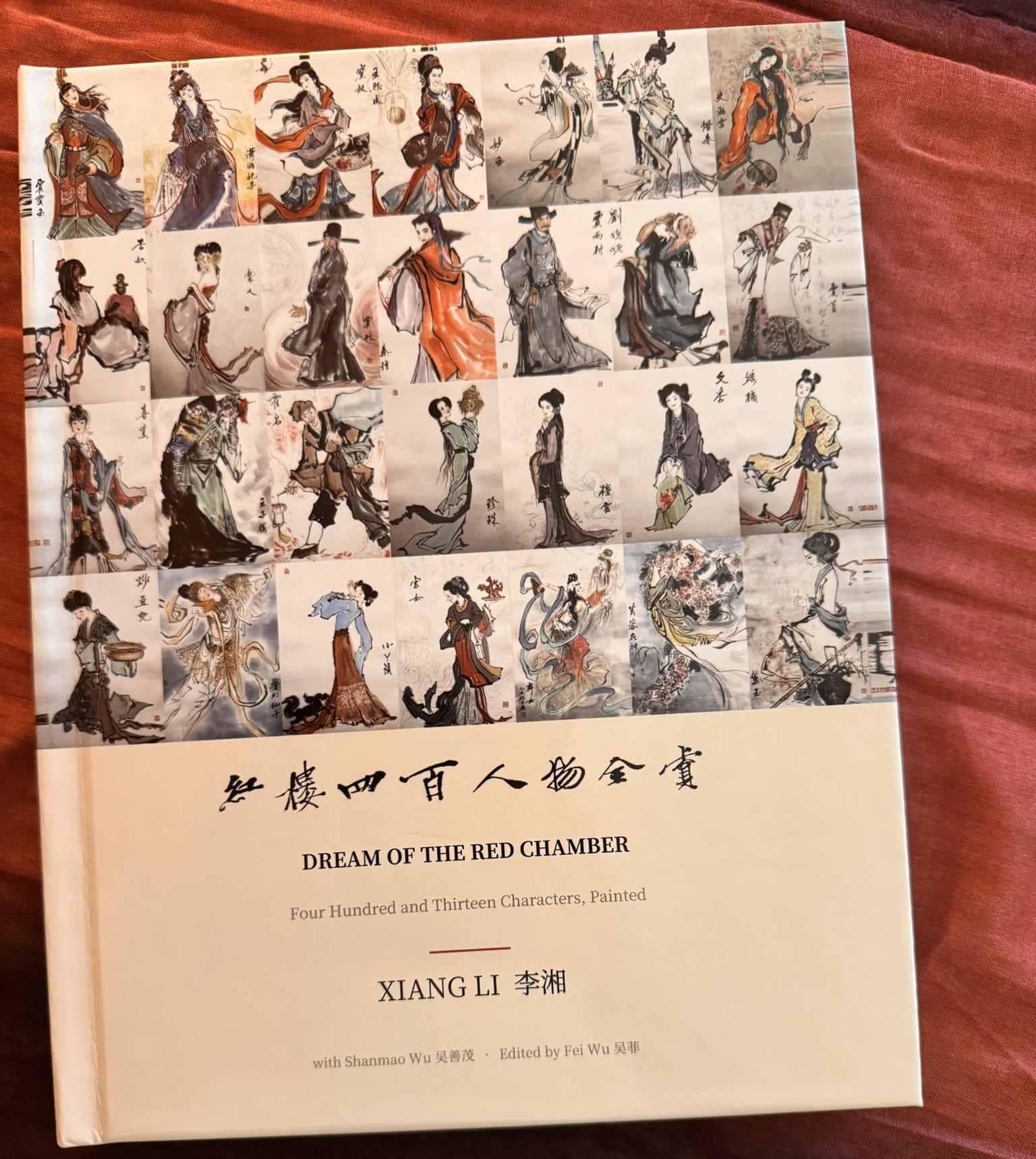
Every Character, Not Just the Twelve Beauties
Cao Xueqin’s 18th-century novel has about thirty principal characters and more than four hundred minor ones. For two centuries, painters have gone back to the same few faces: the Twelve Beauties of Jinling and the restless young hero, Jia Baoyu. Lin Daiyu with her hoe and fallen petals, Xue Baochai with her fan. These are the images people know.
Xiang Li painted those too. Then she kept going, through the servants, the wet-nurses, the monks, the country girls and the palace guards, all the way down to the people who appear in the novel for a single line. She painted all 413 of them. In everything I have read since I first came to this collection, I have not found another artist anywhere in the world who has painted every character in Dream of the Red Chamber. The book puts her reason simply: “Everyone paints the twelve beauties. I wanted the ones nobody paints.”
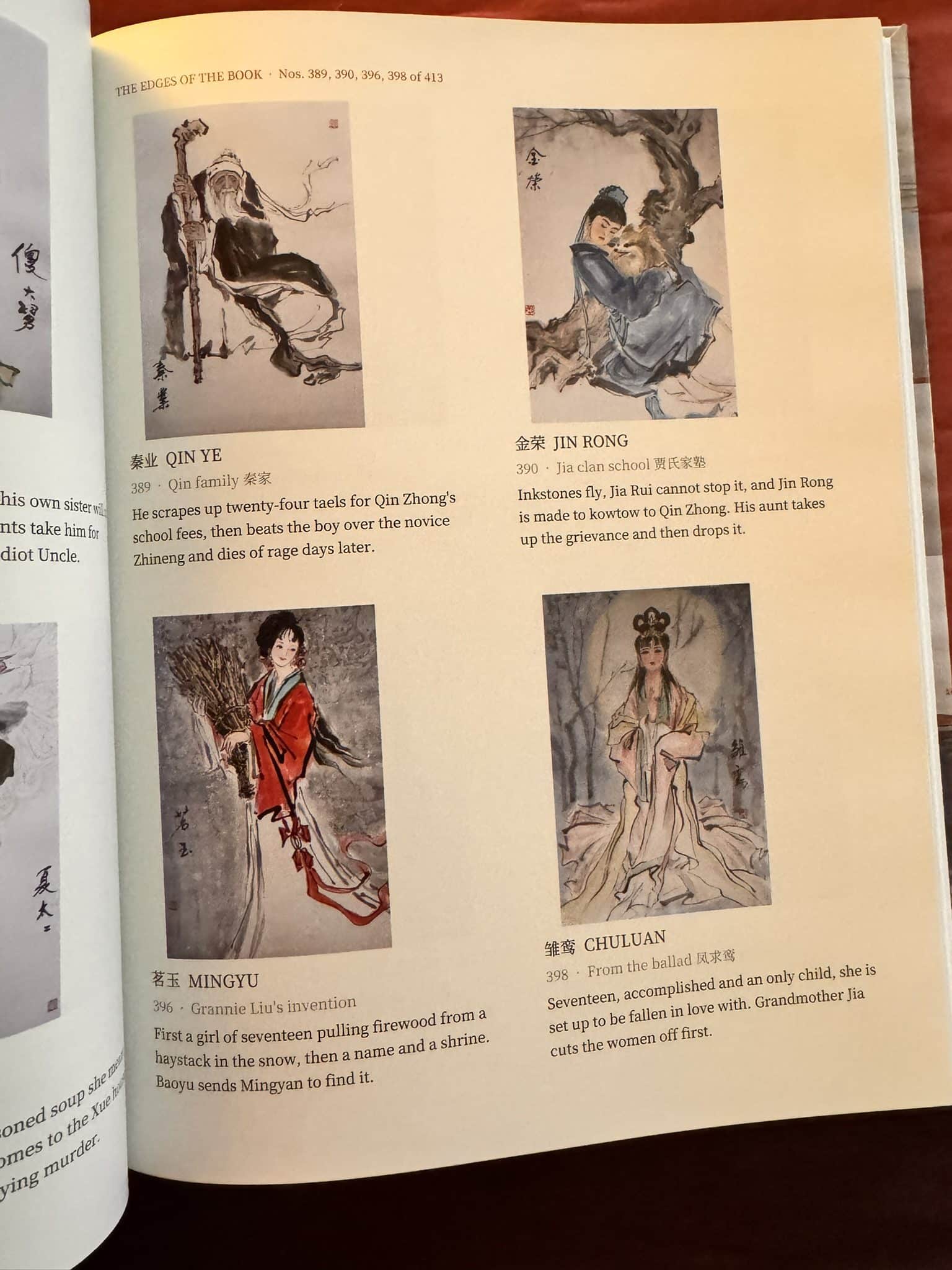
Turning these pages, I found myself lingering longest over the people the novel hardly notices. Here is Mingyu, a girl Grannie Liu invents on the spot: seventeen, pulling firewood from a haystack in the snow. Xiang Li gives her a red jacket and an armful of branches, and she is suddenly as real as anyone in the Jia household. Here is Baoyu’s son, who, as the book’s note says, “reaches the novel as an heir and never as a person.” Xiang Li paints him as a plump baby asleep in a swirl of vermilion. Here is Er Ya Tou, “Second Girl,” a country form of address that is all the novel ever gives her. And here is Yingchun’s wet-nurse, the woman who pawns her mistress’s gold phoenix hairpin in Chapter 73 to cover her gambling debts.
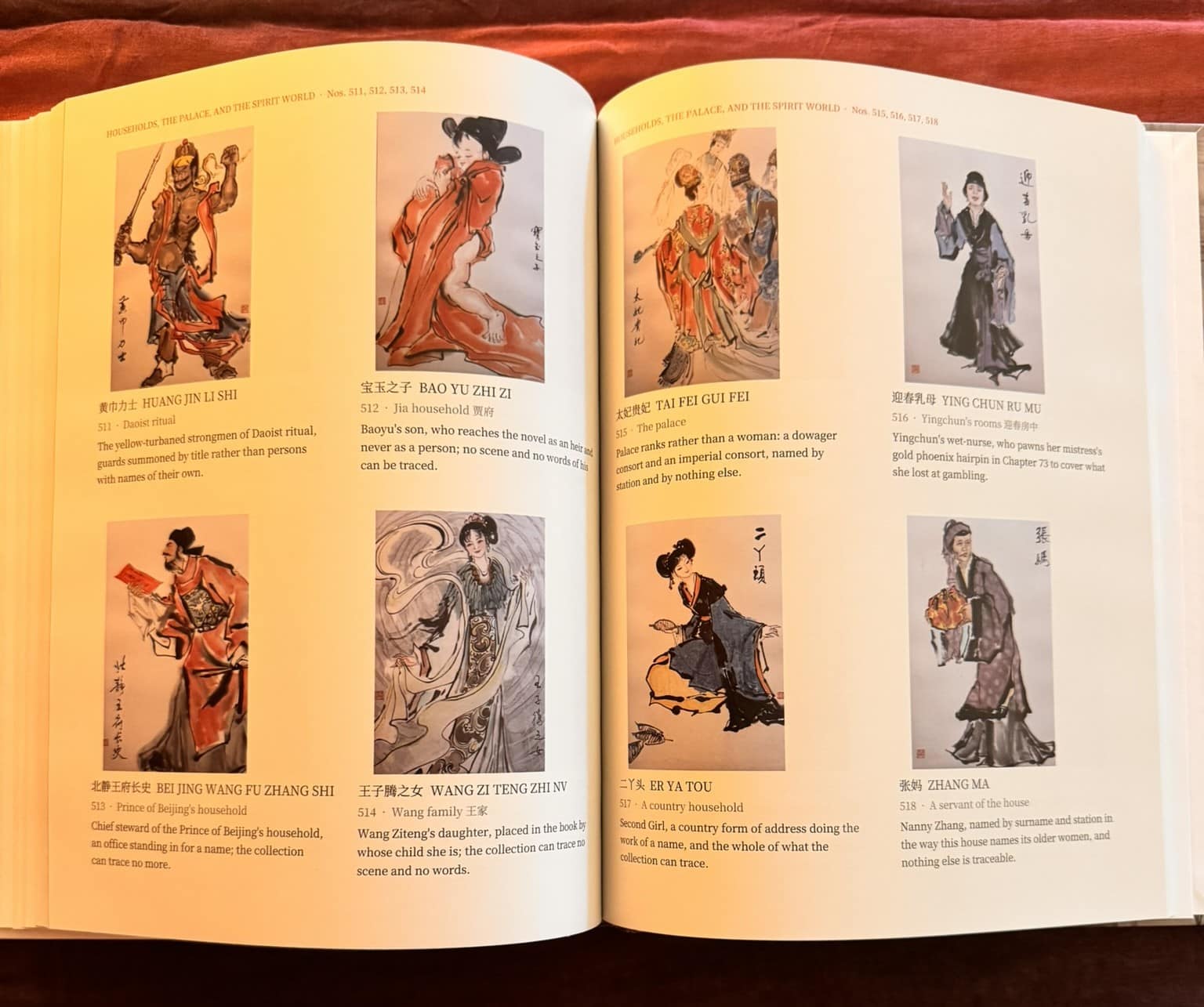
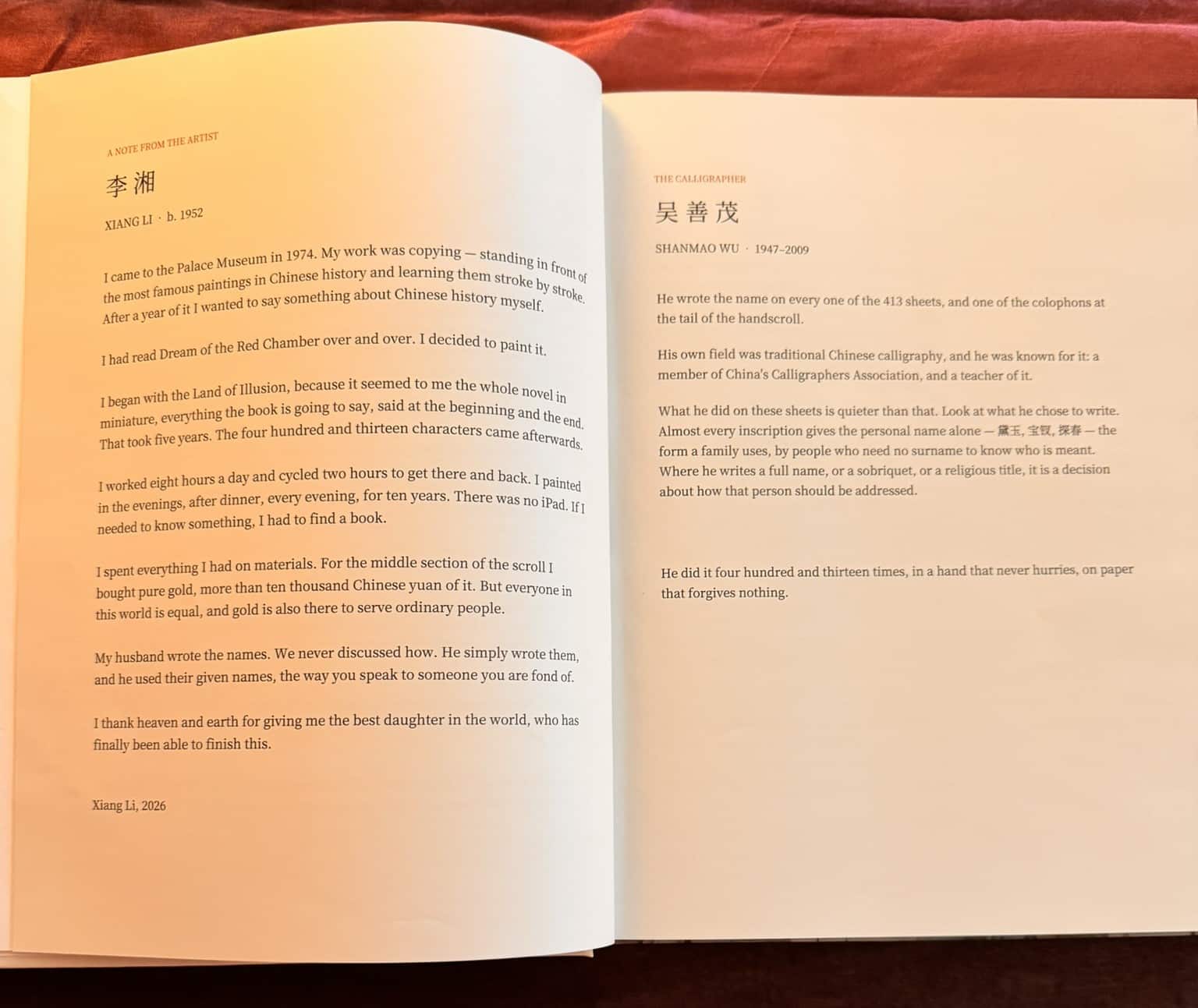
This is what amazes me most. To paint all 413, Xiang Li first had to read the whole novel and understand every single character in it, including the ones Cao Xueqin left as a title or a surname. Then she had to do something harder. She had to imagine each one and give a face, a posture, a robe and a mood to someone the author described in a sentence or not at all. In her note at the front of the book, she remembers how she did it. She was a copyist at the Palace Museum in Beijing from 1974. She worked eight hours a day and cycled two hours to get there and back. Then she painted every evening, after dinner, for ten years. “There was no iPad,” she writes. “If I needed to know something, I had to find a book.”
A Free-Flowing Gongbi
Gongbi (工笔), “meticulous brush,” is the most disciplined tradition in Chinese figure painting. It uses fine, controlled outlines and patient layers of color. Xiang Li trained in that discipline at the Palace Museum, copying the masters stroke by stroke. In these paintings, she lets it breathe. The faces and hands keep gongbi’s precision. The robes, sleeves and ribbons are released into wet, fluid, calligraphic strokes of ink and watercolor on rice paper. The result is a gongbi that moves.
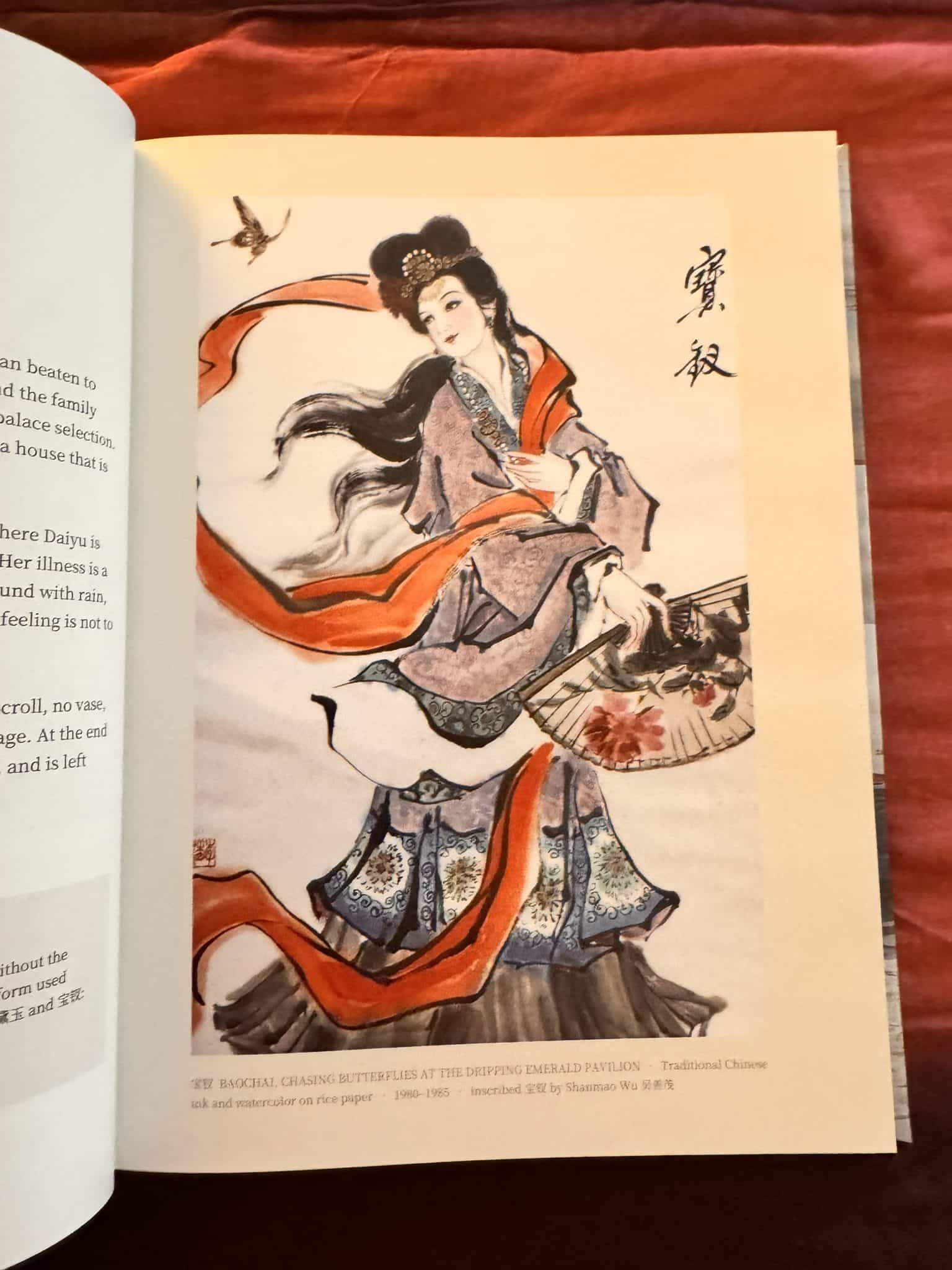
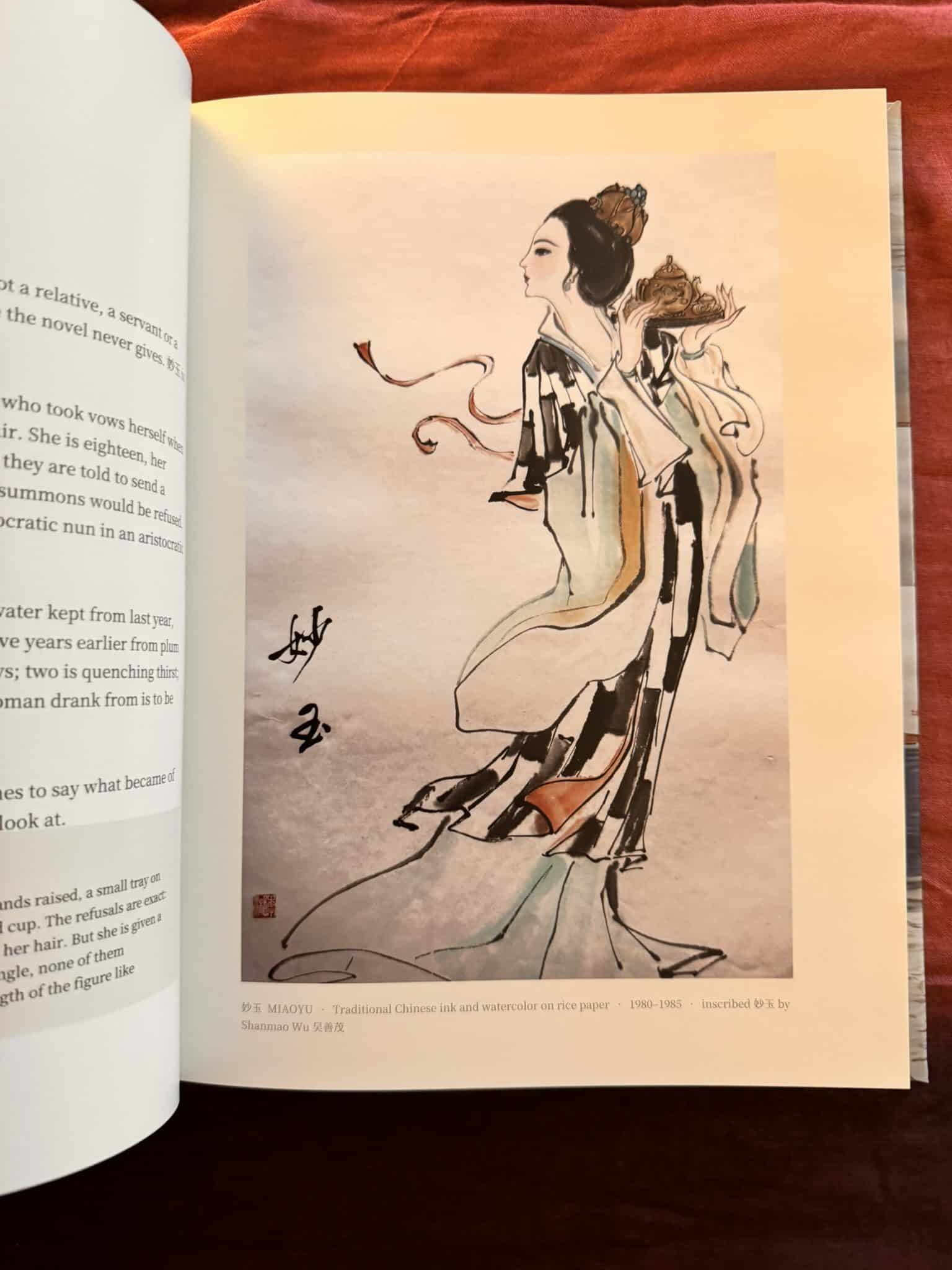
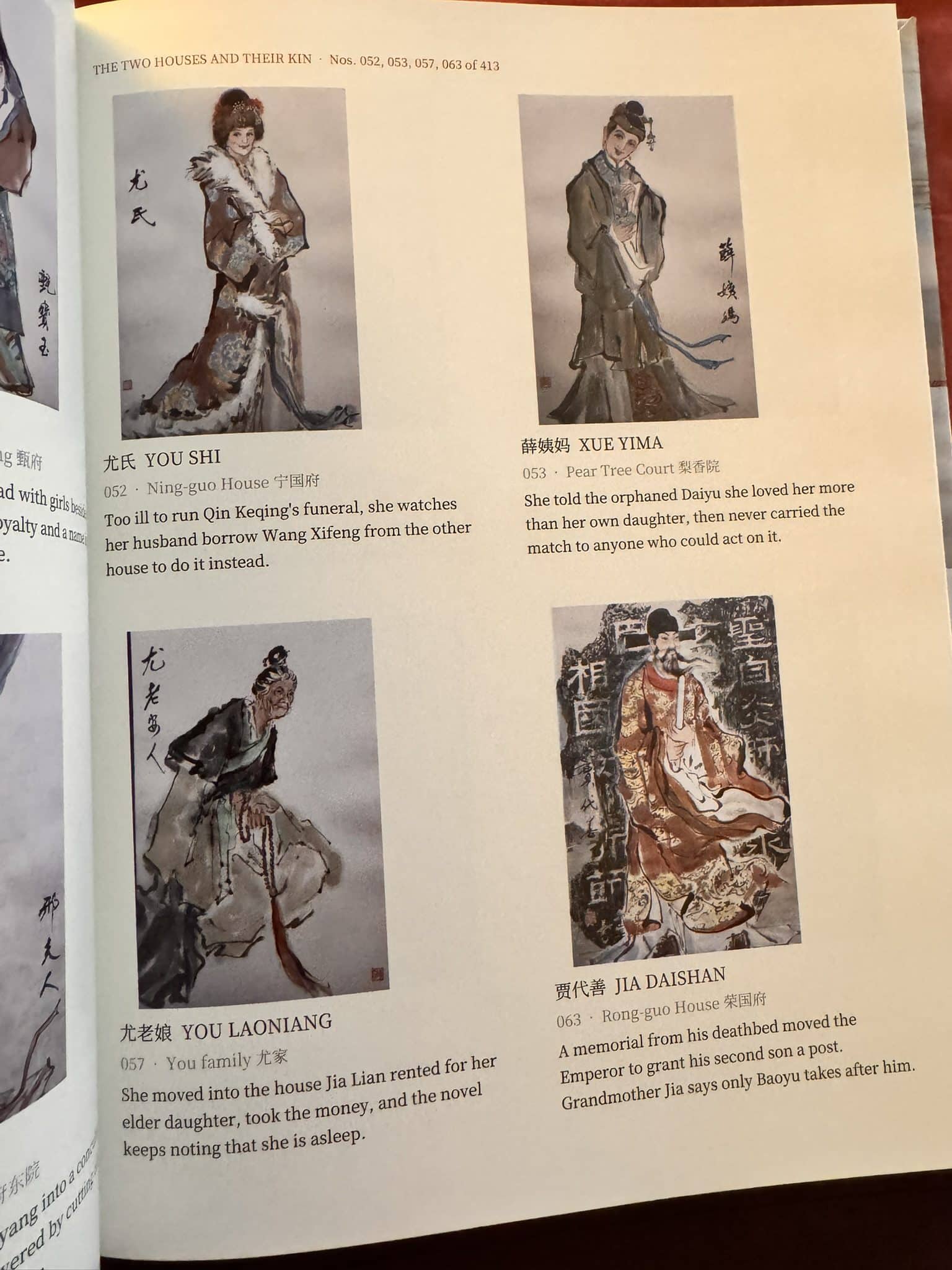
The first thing I noticed is that no two characters look alike. Across 413 portraits, there is no stock face, no repeated pose and no borrowed costume. Each figure is its own composition, and each one is unmistakably someone. These are the details that held me:
- The textiles. Baochai’s lavender robe is edged with cloud scrolls and chrysanthemum roundels, while a vermilion sash whips around her like a flame. You Shi wears a fur-trimmed brocade coat. Jia Daishan, the family’s founding ancestor, stands in a robe of gold dragons against a wall of carved inscriptions. Every pattern is painted, not merely suggested.
- The nature that belongs to each character. A butterfly and a peony-painted fan for Baochai. A gnarled old tree for Jin Rong. Snow and an armful of firewood for Mingyu. A pale moon and bare winter branches behind Chuluan. The landscape is never decoration. It tells you who the person is.
- The expressions. Look at the bowed, weathered face of You Laoniang, prayer beads in her hand. Look at the serene profile of the nun Miaoyu as she carries her tea tray, or the wind-blown beard of the old scholar Qin Ye. Some are proud, some sly, some heartbreaking.
- The palette. Soft slate blues, warm greys and ink blacks, lit by sudden notes of vermilion, ochre, celadon and gold. Even printed, the colors have the luminosity of watercolor on paper.
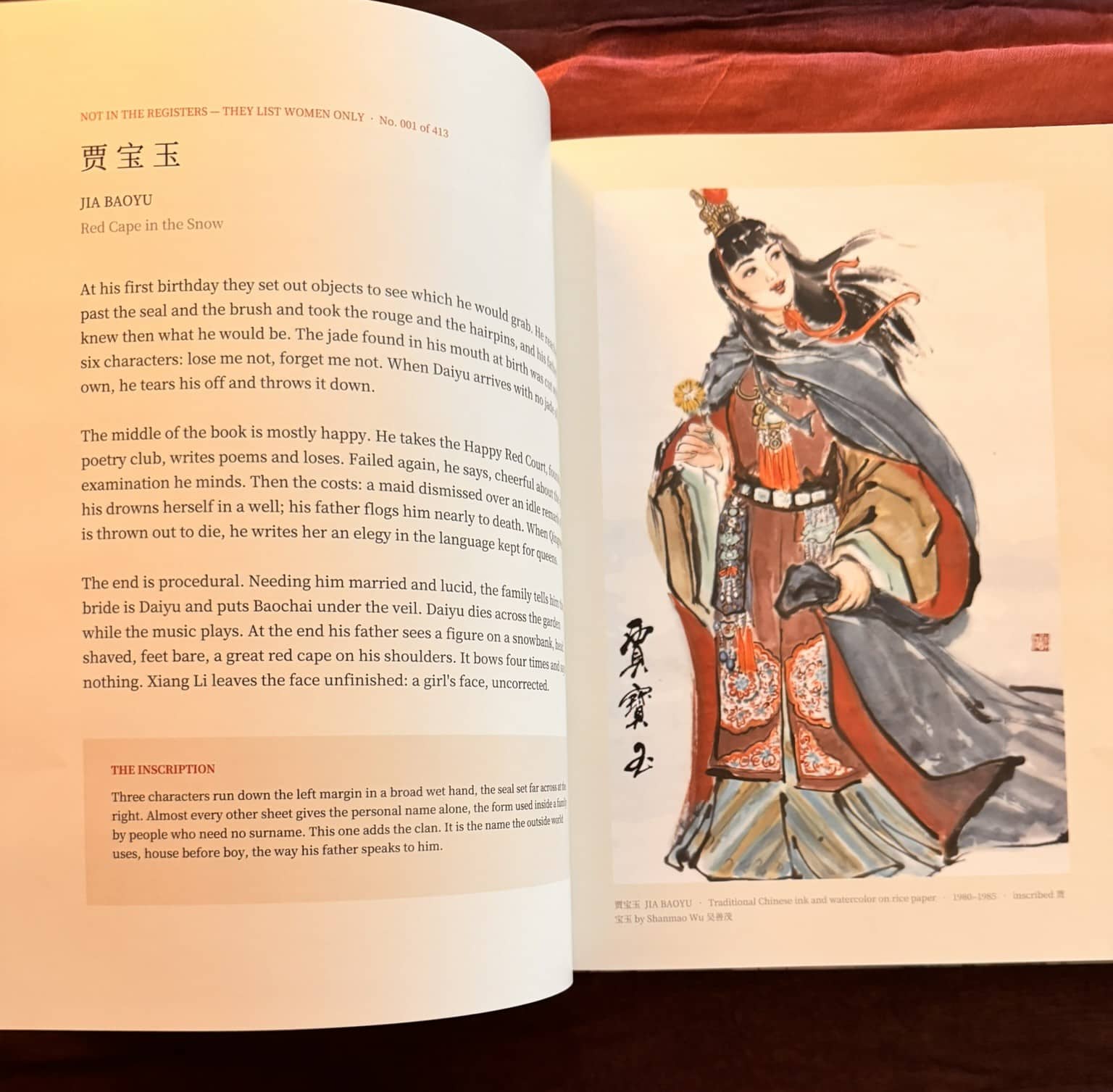
One portrait stopped me completely. Jia Baoyu, the hero of the novel and No. 001 of 413, is painted in a great red cape with a single yellow flower in his hand. The book’s note for him is titled Red Cape in the Snow. It ends: “Xiang Li leaves the face unfinished: a girl’s face, uncorrected.” That one choice captures Baoyu, the boy who believed girls were made of water and men of mud, better than pages of commentary could.
Where It All Began: The Hundred Flower Goddesses
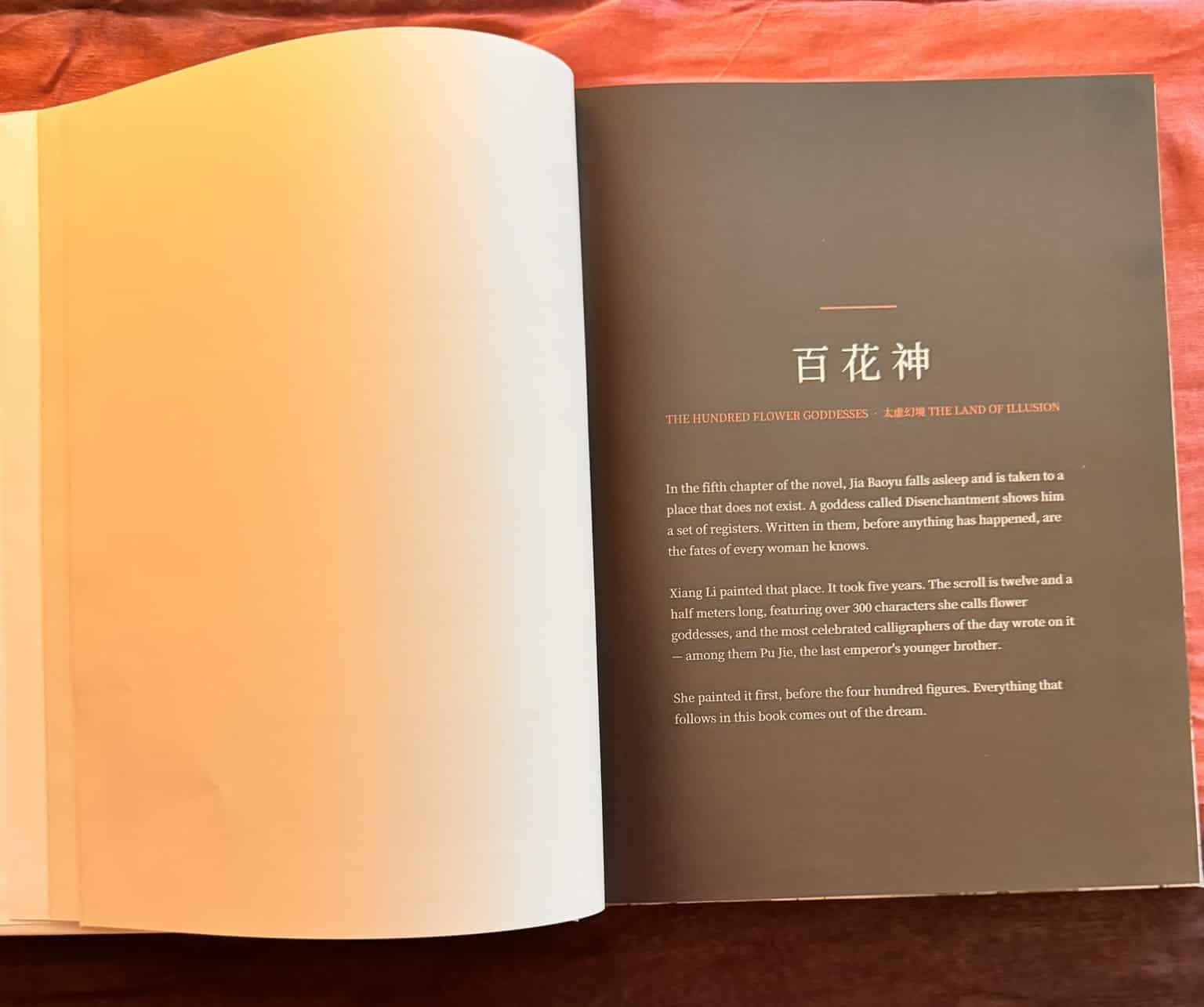
The book opens on something I have written about before and still think about often: Xiang Li’s great silk handscroll, 百花神, The Hundred Flower Goddesses.
In the fifth chapter of the novel, Baoyu falls asleep and is carried into the Land of Illusion. There, the Fairy of Disenchantment, Jinghuan Xiangu, shows him a set of registers. In them, before anything has happened, are written the fates of every woman he knows. Xiang Li painted that place. The scroll is twelve and a half meters long and holds more than 300 figures she calls flower goddesses. It took her five years. For its middle section she bought pure gold, more than ten thousand yuan of it, which was a fortune for a young museum copyist. She explains why with a line I love: “Everyone in this world is equal, and gold is also there to serve ordinary people.”
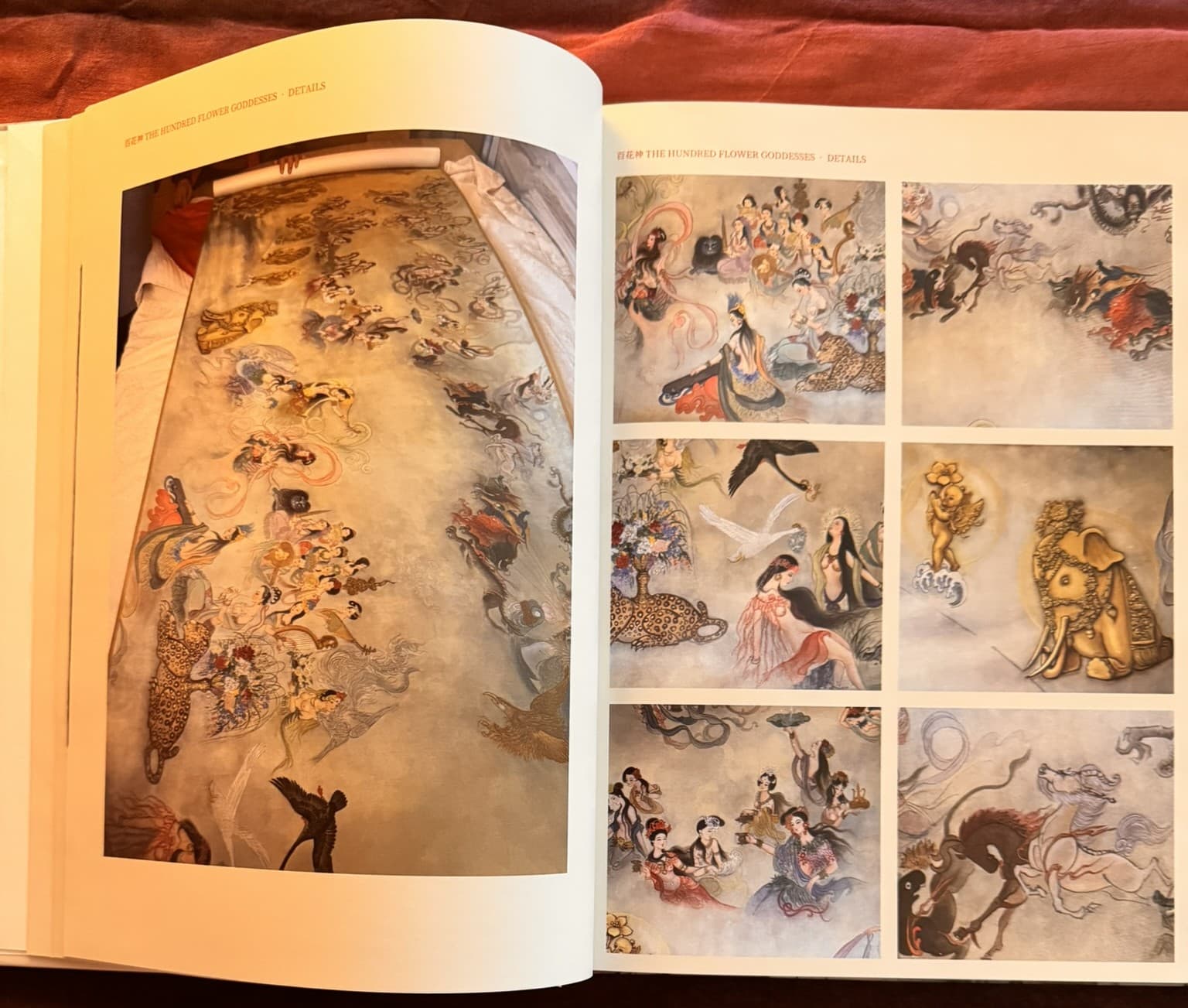
When I saw the scroll unrolled at the artist’s home in January 2025, it was mesmerizing. In my earlier post, I wrote about how it reimagines the women of the Red Chamber. The novel gives them sorrow, exile and early death. Here they are freed from suffering and lifted into music, dance and celestial celebration. The book now gives readers who cannot see the scroll in person something close to it. There is a full photograph of the unrolled silk, then page after page of details. Goddesses play the zither and the harp. Others ride spotted leopards. Swans and cranes pass overhead. Qilin and dragons, horses with flaming manes, and a golden elephant catch the light. Gold glints through cloud and feather everywhere.
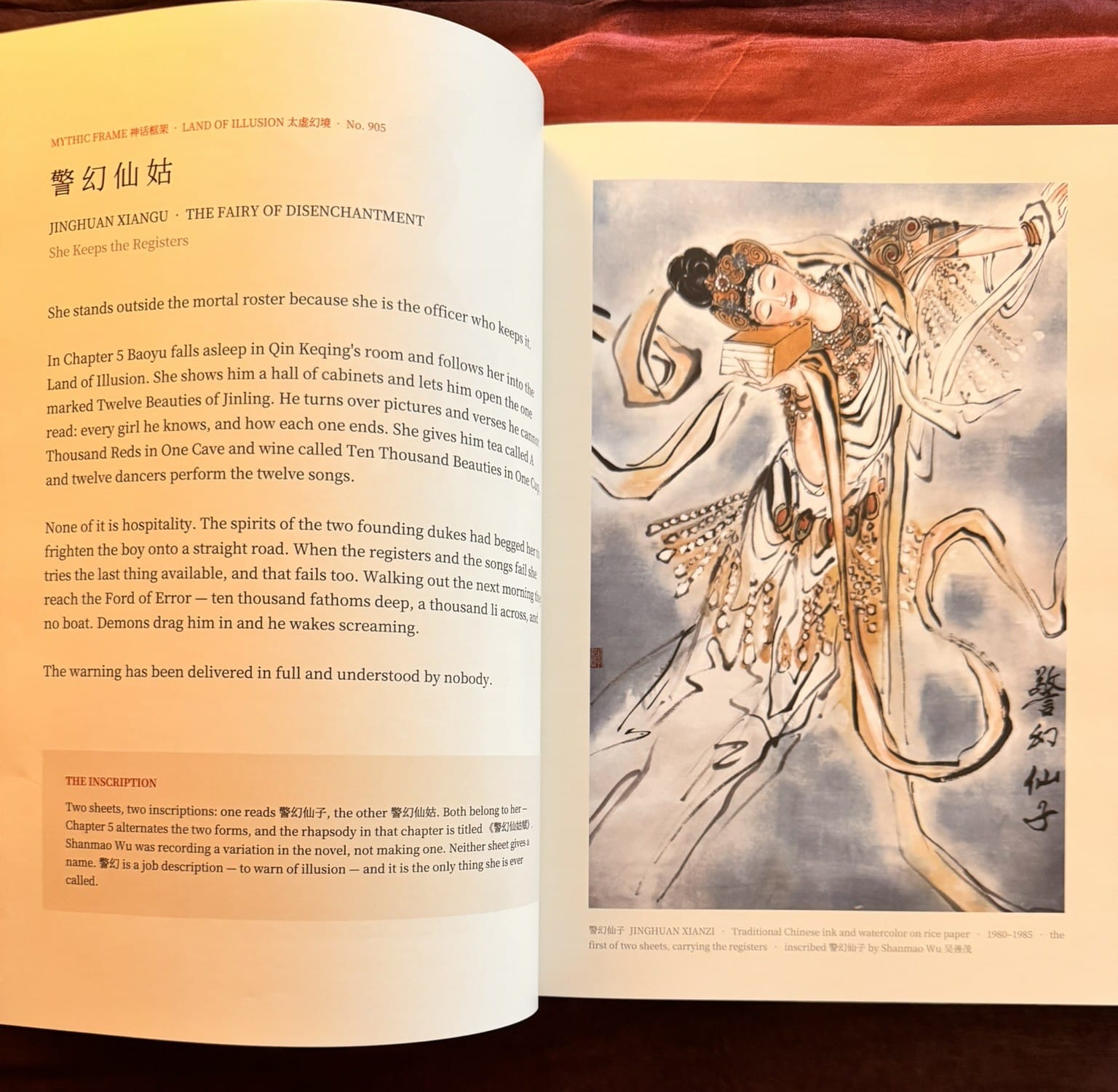
The book also gives the Fairy of Disenchantment her own pages, painted on separate sheets. She dances with the registers held against her cheek, eyes closed, draped in strings of pearls. The note beside her ends with a sentence that could stand for the whole novel: “The warning has been delivered in full and understood by nobody.”
At the end of the scroll is the colophon, where some of the most celebrated calligraphers and scholars of the day added their inscriptions. Among them are Dong Shouping, Pu Jie (younger brother of Puyi, China’s last emperor), Fan Zeng, Zhou Ruchang (the leading scholar of the novel), Xu Zhiqian and Xiang Li’s own husband, Shanmao Wu.
The Calligrapher’s Hand
Look closely at any portrait in this book and you will find a second artist at work. The vertical line of characters beside each figure is the name, written by Shanmao Wu (吴善茂, 1947–2009). He was a respected calligrapher in China, a member of the China Calligraphers Association and a teacher of the art. He inscribed every one of the 413 sheets, and he also wrote one of the colophons at the tail of the Hundred Flower Goddesses scroll.
The book points out something I would never have noticed on my own. On almost every sheet, he wrote only the personal name: 黛玉, 宝钗, 探春. That is how a family speaks, among people who need no surname to know who is meant. Where he chose a full name, a nickname or a religious title, it was a decision about how that person should be addressed. Baoyu is one of the rare exceptions. His sheet carries the clan name too, “house before boy, the way his father speaks to him.”
Xiang Li’s own words about this collaboration are among the most tender in the book:
“My husband wrote the names. We never discussed how. He simply wrote them, and he used their given names, the way you speak to someone you are fond of.”
The editor sum up his work in a single line: “He did it four hundred and thirteen times, in a hand that never hurries, on paper that forgives nothing.”
Shanmao Wu died in 2009. He never saw this book. Knowing that, I find it impossible to look at those inscriptions without emotion. His hand is on every page.
A Daughter’s Tribute
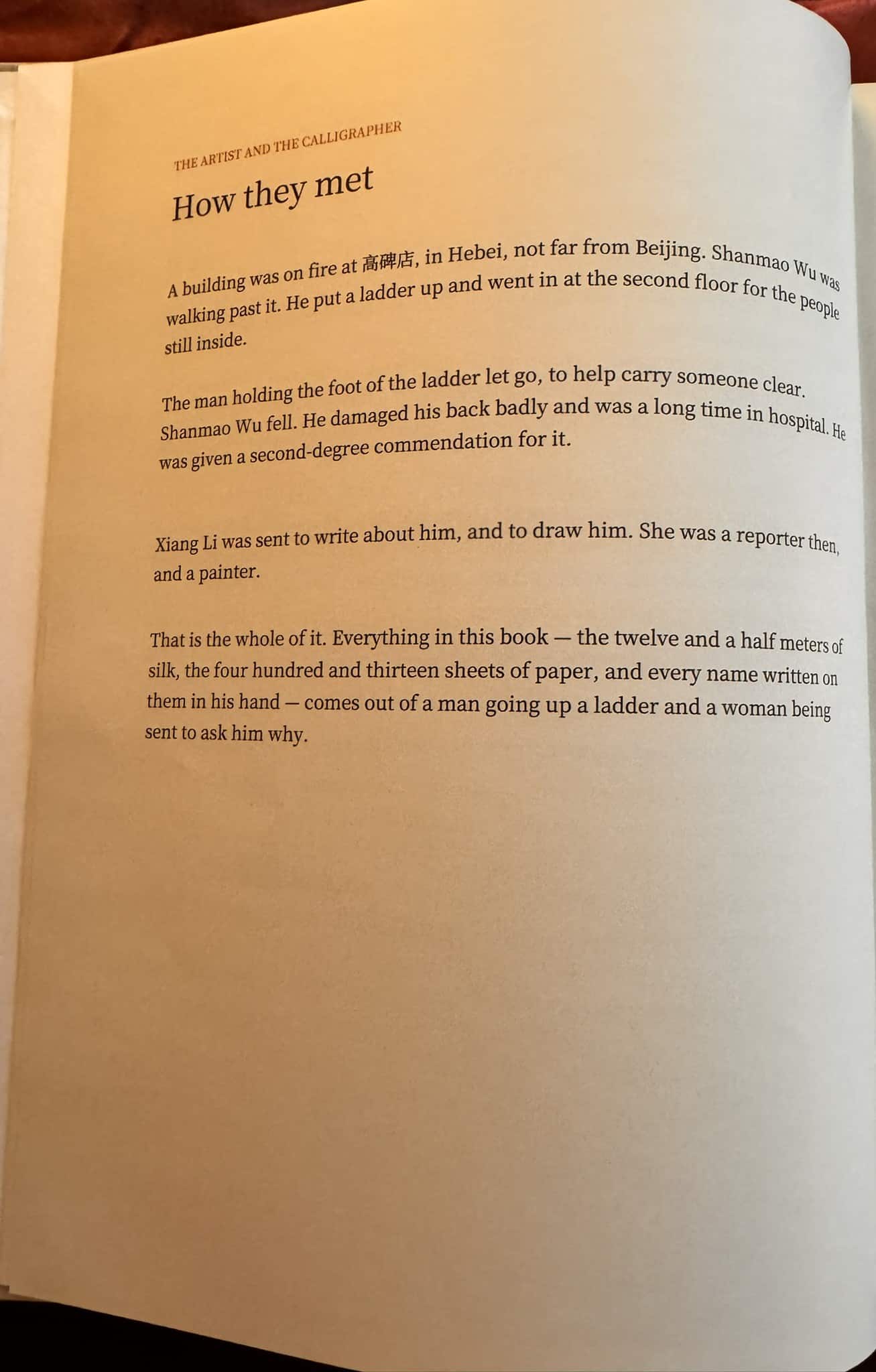
The book holds a love story, and it is told in a few spare lines. Shanmao Wu was walking past a burning building in Gaobeidian, Hebei, when he put up a ladder and climbed in for the people still trapped inside. He fell and was badly hurt. A young reporter and painter named Xiang Li was sent to write about him and to draw him. In the book’s words, everything in these pages “comes out of a man going up a ladder and a woman being sent to ask him why.”
This book was edited by their daughter, Fei Wu (吴菲), and it is, above all, her tribute to both her parents. She has given her mother’s decade of evenings and her father’s 413 inscriptions the home they always deserved. She has done it with real restraint and intelligence. The short notes beneath each portrait are often a single sentence, yet they are sharp, witty and full of feeling. They sent me back to the novel again and again. The design is quiet, the paper is generous and the paintings are given room to speak.
There is a photograph near the front that I keep returning to: a young Xiang Li and Shanmao Wu, cheek to cheek, with baby Fei between them in a red-and-white knit hat. Each is labeled with the role they would one day play in this book: Artist, Editor, Calligrapher.
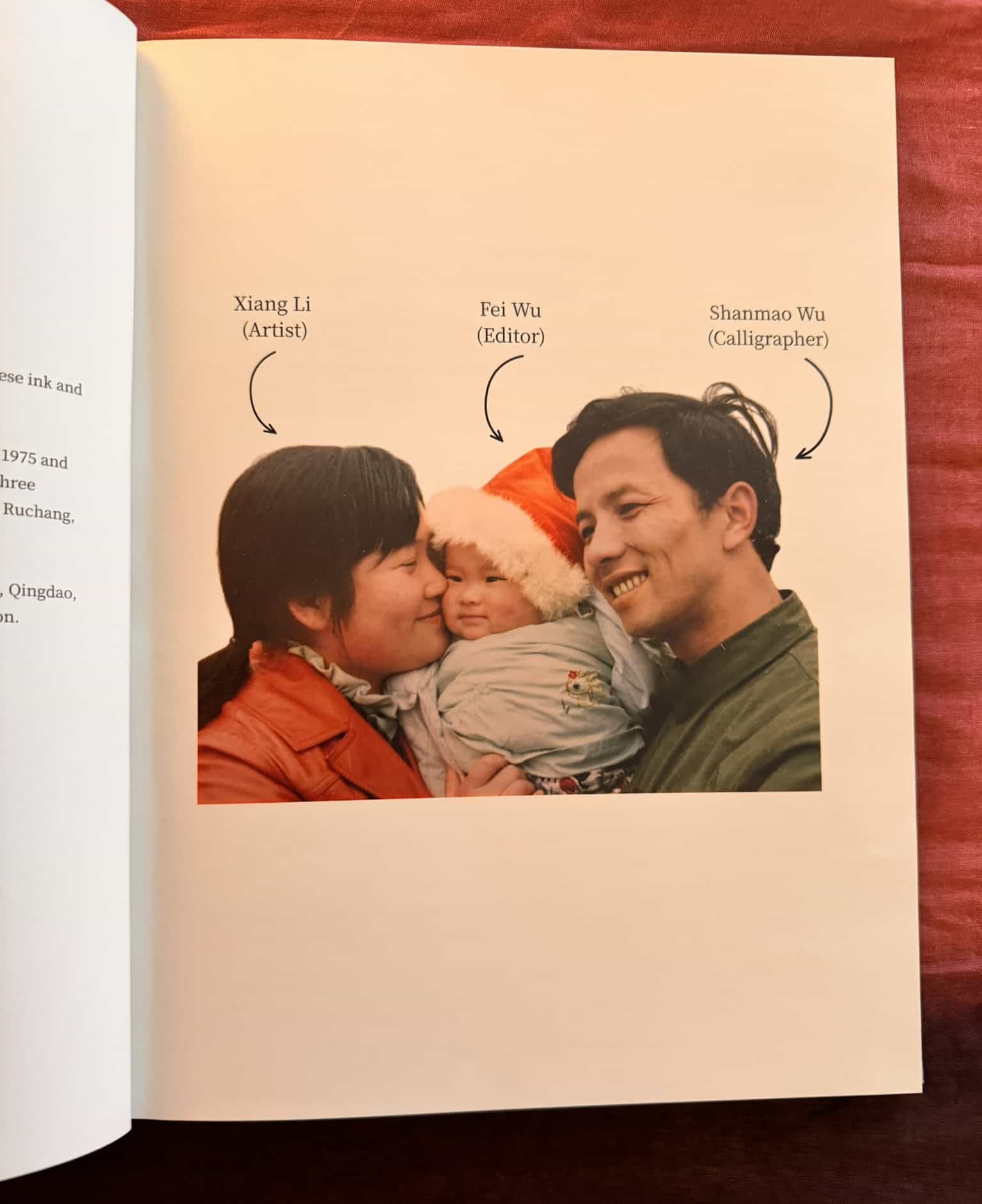
Xiang Li closes her note at the front of the book with this sentence, and I cannot think of a better review of Fei Wu’s work:
“I thank heaven and earth for giving me the best daughter in the world, who has finally been able to finish this.”
More Than a Catalogue
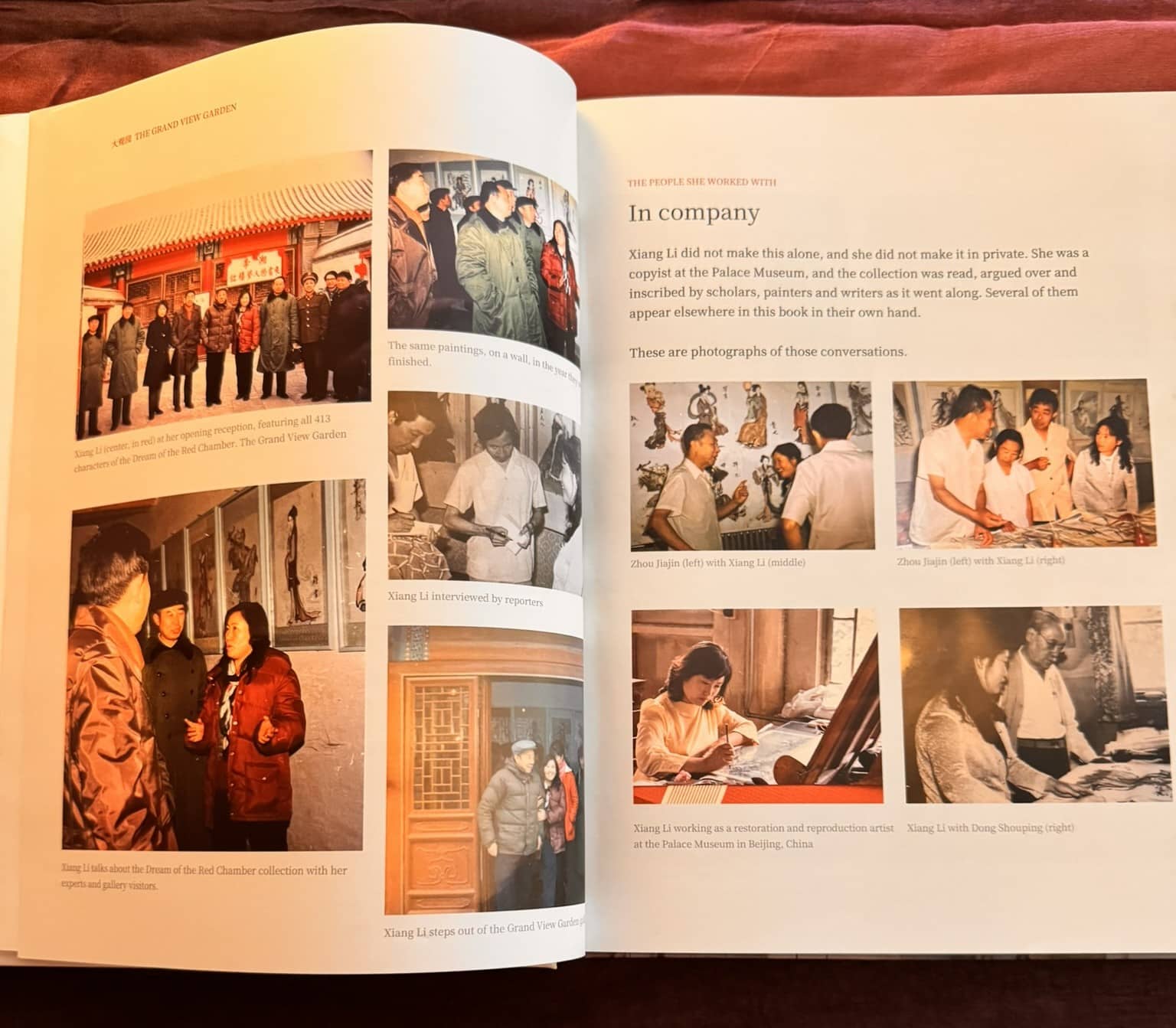
What lifts this book above a beautiful catalogue is its archive. Fei Wu has gathered photographs, letters and inscriptions that show this collection was never made in isolation. As the book puts it, “Xiang Li did not make this alone, and she did not make it in private.” We see her at work as a restoration and reproduction artist at the Palace Museum. We see her bent over paintings with Dong Shouping and debating with leading Redology scholars. And we see her in a red coat at the 1985 opening reception at Beijing’s Grand View Garden, where all 413 characters hung on the walls together.
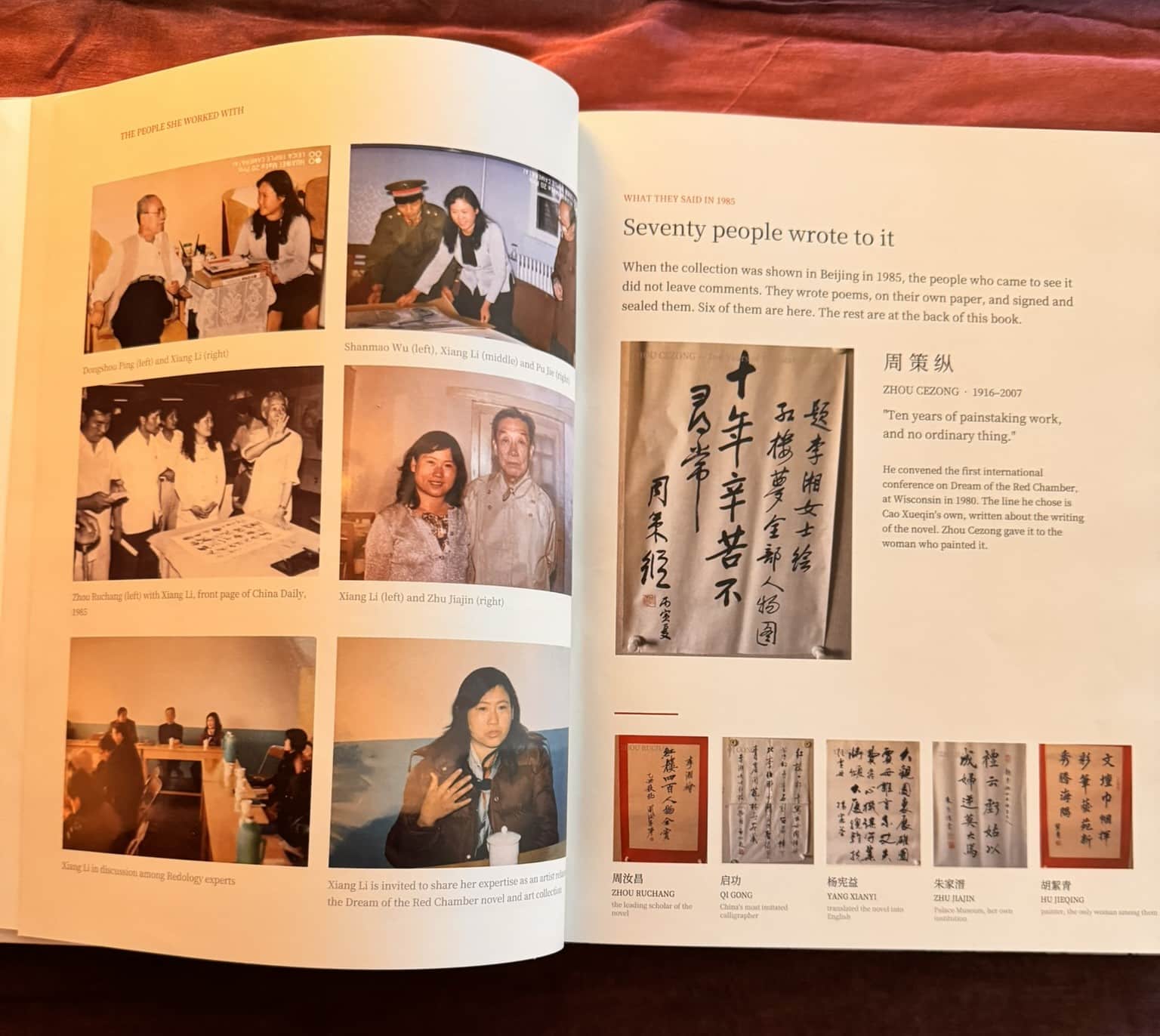
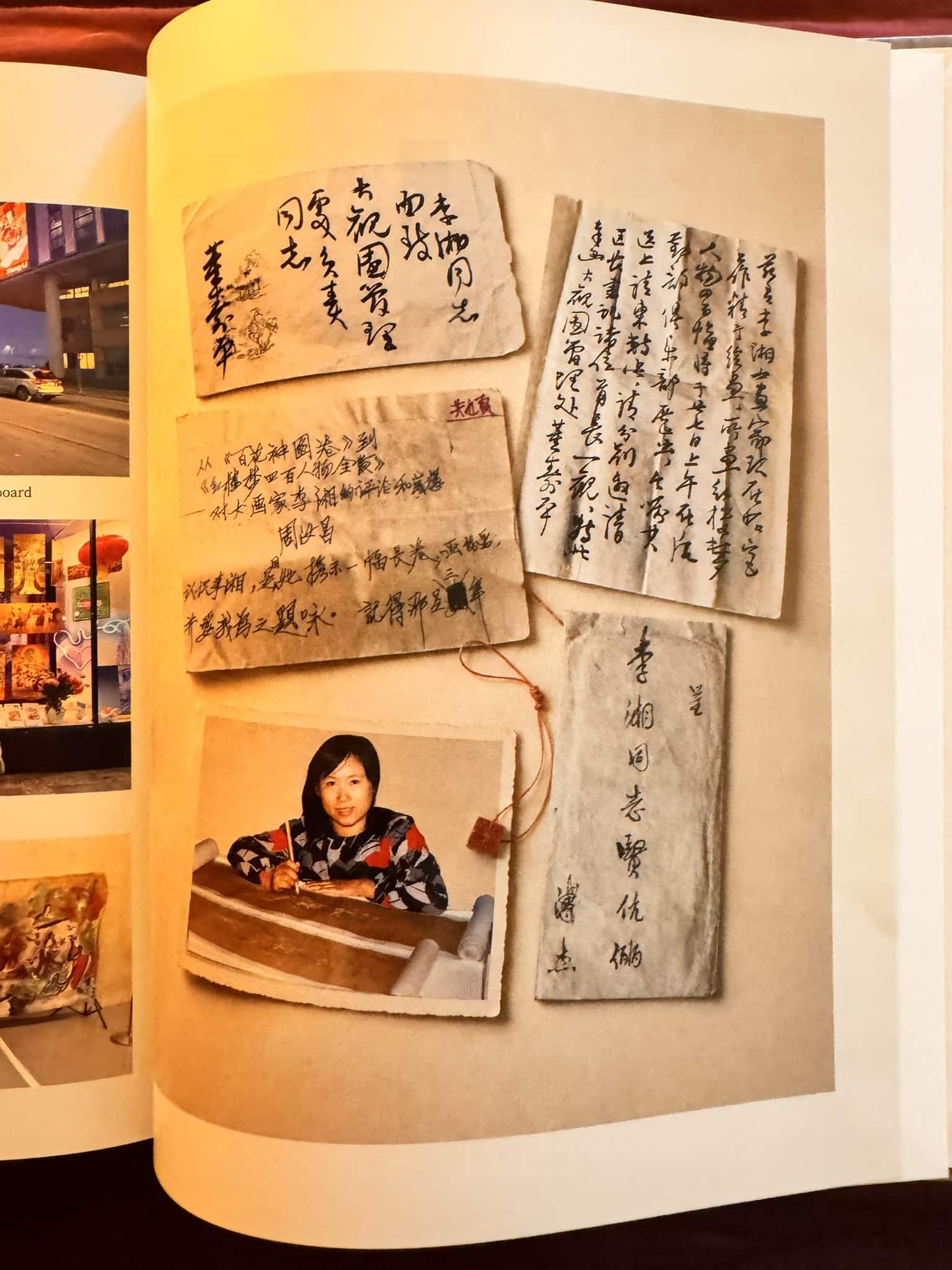
My favorite discovery is the chapter called Seventy People Wrote to It. When the collection was shown in Beijing in 1985, visitors did not leave comments in a guest book. They wrote poems, on their own paper, and signed and sealed them. Among them were Zhou Cezong, who convened the first international conference on the novel; the great calligrapher Qi Gong; Yang Xianyi, who translated the novel into English; Zhu Jiajin of the Palace Museum; and the painter Hu Jieqing. Zhou Cezong chose a line Cao Xueqin had written about his own novel: “Ten years of painstaking work, and no ordinary thing.”
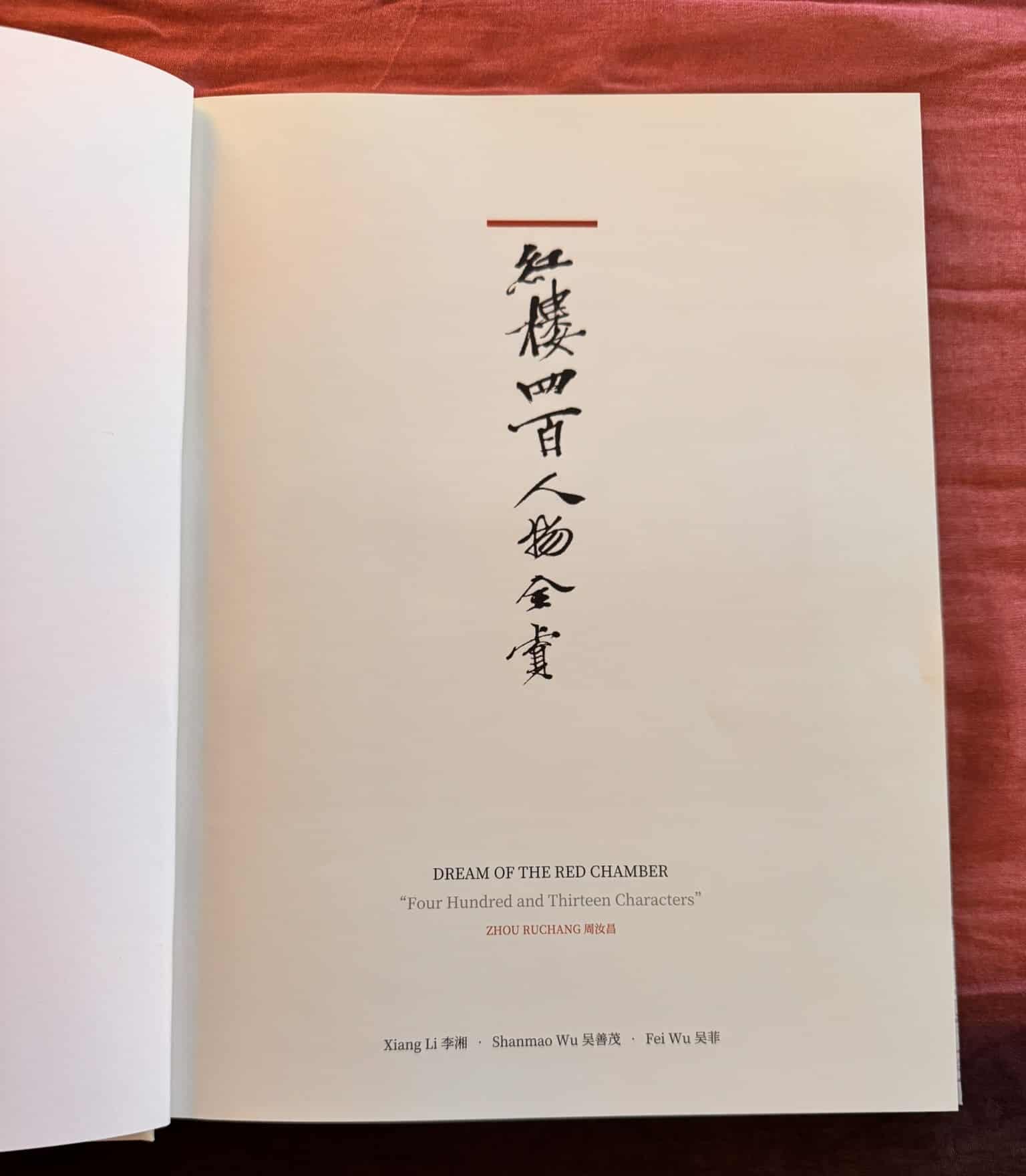
There are letters and envelopes, worn soft with age, including one signed by Pu Jie. There is a full index of the characters in Chinese and English. Even the title page carries the calligraphy of Zhou Ruchang, the leading scholar of the novel.
Final Thoughts
I came to Dream of the Red Chamber through Xiang Li’s paintings, not through the novel, and this book has made me a more devoted reader of both. It is a museum exhibition you can hold in your lap. It is a field guide to one of the world’s great novels. And it is a family portrait made by three people across half a century. In my opinion, it is one of the most beautiful and meaningful art books I have held in my hands.
It would make a treasured gift for:
- The art lover, who will appreciate 413 original compositions and a twelve-and-a-half-meter scroll in one volume.
- The lover of Chinese literature and history, especially anyone who has read, studied or always meant to read Dream of the Red Chamber.
- The watercolor and ink painter, who will learn something new about line, wash and color on every page.
- Anyone who loves textiles, costume and design, because the robes alone are worth the book.
How to Order
The book is available to order online from xiangliart.com. As of this writing, the details are:
- Standard copy: a 10 × 12 inch hardcover, 264 full-color pages, for $120. Each copy is printed to order and ships worldwide. A Chinese-language edition is also available.
- Signed copy: you can request a copy signed by the artist, Xiang Li, in Chinese, and by the editor, Fei Wu, in English, with a personal inscription of your choice. It is the same price, with free shipping within the US. Signed copies are fulfilled by the studio, so please allow a little more time. Request one through the form on the book’s page.
- Libraries, museums and bulk orders: discounted pricing is available. Write to the studio at xiangliart@gmail.com.
If you would like to see the paintings before ordering, the full collection can also be browsed for free in the online gallery on xiangliart.com.
Further reading on this blog: