From Ithaca to Imperial China: Power, Trust, and the Choices That Shape a Dynasty
July 28, 2026 · Fei Wu · 20 min read
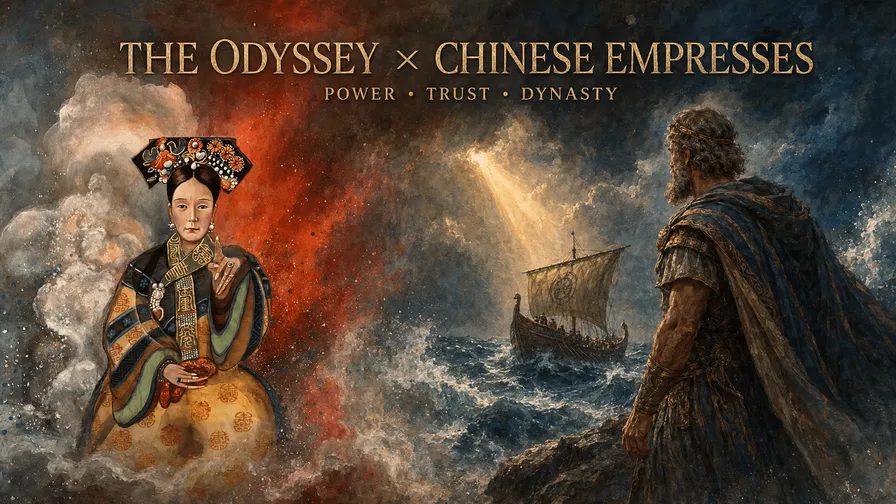
Reflections inspired by Christopher Nolan’s 2026 film The Odyssey and Xiang Li’s Chinese Empresses collection.
A quick note before you read: This article discusses themes and several well-known myths from Homer’s Odyssey, but it does not reveal the movie’s major surprises or ending. Christopher Nolan’s The Odyssey is still absolutely worth experiencing on the big screen—its scale, performances, imagery, and emotional intensity cannot be captured in a summary. We highly recommend seeing it for yourself!
When I watched Christopher Nolan’s The Odyssey, I expected an extraordinary cinematic journey: the fall of Troy, dangerous seas, mythical creatures, tests of loyalty, and one king’s struggle to return home.
The movie, starring Matt Damon as Odysseus, Anne Hathaway as Penelope, Tom Holland as Telemachus, and an impressive ensemble cast, gives Homer’s ancient epic an enormous physical and emotional scale. Released on July 17, 2026, it was also the first feature film shot entirely with IMAX film cameras. (Official film website)
But while watching, I kept thinking about my mother Xiang Li’s Chinese Empresses collection—not only about the women in the paintings, but also about the emperors, princes, advisers, generals, relatives, servants, and rival families surrounding them.
An empire, like a ship, is never guided by one person alone.
An emperor might appear all-powerful, but his survival depends on knowing whom to trust. He must decide which advice is honest, which loyalty is temporary, which apparent victory will create future danger, and which sacrifice might protect the dynasty in the long run.
An empress faces similar questions. She may be a wife, political partner, mother of an heir, adviser, mediator, rival, or regent. Her relationship with the emperor can influence not only their family, but the future of an entire dynasty.
This is where The Odyssey and the stories of imperial China begin to meet.
Ancient Greece and imperial China were profoundly different civilizations. Their histories should never be collapsed into simple equivalents. Yet their stories explore many of the same human problems: power, ambition, loyalty, temptation, leadership, succession, family, and the difficulty of recognizing truth before it is too late.
The Trojan Horse: When a Brilliant Victory Creates a Dangerous Future
The Trojan Horse is one of history’s most famous military strategies. After years of unsuccessful war, the Greeks gain entry into Troy through deception. It is a brilliant short-term solution.
But the victory does not bring peace.
Troy falls, yet the violence of the war follows the Greeks home. Odysseus’s cleverness helps win the conflict, but his journey is only beginning. The consequences of victory become another kind of battlefield.
Imperial Chinese history contains many similar moments. A ruler might defeat a rival, remove a threatening official, secure an alliance through marriage, or place a favored son in the line of succession. The immediate problem appears solved but the decision may create resentment, rebellion, factional conflict, or instability years later.
The history of Emperor Wen of the Sui dynasty and Empress Wenxian, also known as Empress Dugu, offers one example.
They shared an unusually close political and personal partnership. Empress Dugu was intelligent, influential, and deeply involved in court affairs. Together, they helped establish and strengthen the Sui dynasty.
Yet decisions within their own family contributed to its vulnerability. Their eldest son, Yang Yong, was removed as crown prince, and their second son, Yang Guang, eventually became Emperor Yang of Sui. Although Yang Guang accomplished major projects, his costly campaigns and demands on the population helped accelerate the dynasty’s collapse.
A decision that appeared politically necessary inside the palace had consequences across the empire.
The Trojan Horse therefore raises a question that every ruler must confront:
Is this a true victory, or simply a future crisis hidden inside a present success?
The Cyclops: Power Without Restraint
The Cyclops Polyphemus possesses enormous physical power but lives without law, hospitality, or accountability. Odysseus defeats him through intelligence rather than strength.
Yet Odysseus also makes a dangerous mistake. After escaping, he reveals his identity. His desire to claim credit turns survival into a longer conflict.
This is one of the most timeless warnings in The Odyssey: intelligence can save a leader, but pride can undo the victory.
Chinese emperors were often described as Sons of Heaven, but their power was not supposed to be limitless. Confucian political thought emphasized moral responsibility, proper conduct, and the ruler’s obligation to listen to honest remonstrance.
The most successful emperors understood that unchecked power could isolate them from reality.
Emperor Taizong of the Tang dynasty is remembered not only for military and political success, but also for his willingness, at least during important periods of his reign, to listen to criticism. The official Wei Zheng became famous for giving him direct and sometimes uncomfortable advice.
Empress Zhangsun also played a meaningful role in this political environment. She was not simply a supportive wife. Traditional accounts portray her as thoughtful, educated, and capable of calming the emperor when his anger threatened to overpower his judgment. She understood that an adviser willing to disagree with the emperor could be more valuable than a courtier who offered only praise.
The relationship among Emperor Taizong, Empress Zhangsun, and Wei Zheng illustrates something Odysseus sometimes struggles to remember:
A powerful ruler still needs restraints.
The person who challenges a leader may be more loyal than the person who agrees with everything.
Aeolus and the Bag of Winds: The Fragility of Trust
Aeolus gives Odysseus a bag containing the winds and provides him with the opportunity to sail home. But Odysseus does not fully explain the gift to his crew.
Suspicious that their leader is secretly keeping treasure, the men open the bag. The winds escape, and the ship is blown away from Ithaca just as the journey is nearly complete.
This disaster is not caused by a monster. It is caused by mistrust.
Odysseus does not trust his crew enough to share what he knows. His crew does not trust him enough to leave the bag unopened. Everyone suffers.
The same pattern repeatedly appears in imperial courts.
An emperor’s court was filled with people who possessed different amounts of information. Empresses, princes, ministers, military commanders, eunuchs, and members of powerful families might each understand only part of what was happening.
Secrecy was sometimes necessary. But too much secrecy created suspicion. An emperor who trusted no one could become isolated. An official who misunderstood the ruler’s intentions might join a rival faction. An empress who feared for her child’s safety might take actions the emperor interpreted as disloyal.
Near the end of the Eastern Han dynasty, Emperor Xian occupied the throne but exercised very little independent power. Cao Cao controlled the imperial court and much of the empire in the emperor’s name.
Empress Fushou reportedly attempted to resist Cao Cao’s growing control. Her actions were discovered, and she was removed and killed. Cao Cao’s daughter, Cao Jie, later became Emperor Xian’s empress. When Cao Cao’s son Cao Pi forced Emperor Xian to abdicate, Cao Jie found herself caught between her husband and her birth family.
This was not simply a conflict between men and women. It was a crisis of divided loyalty involving marriage, family, imperial legitimacy, and survival.
When everyone is guarding a different bag of winds, how can anyone know whom to trust?
The Lotus-Eaters: Comfort, Complacency, and the Loss of Purpose
The Lotus-Eaters do not defeat Odysseus’s men through violence. Instead, the lotus causes them to forget their desire to return home.
The danger is comfort without purpose.
Dynasties could face a similar temptation. A court enriched by earlier victories might become absorbed in luxury, entertainment, ceremony, or internal competition. Officials might focus more on protecting their positions than serving the empire. Members of the imperial family might forget the hardship and discipline that allowed their ancestors to establish the dynasty.
The threat does not always arrive as an invading army. Sometimes it appears as complacency.
A ruler may continue receiving beautiful reports while problems grow beyond the palace walls. Local corruption, high taxation, military overextension, famine, and public resentment can remain invisible when the court hears only what it wants to hear.
The lotus is therefore not merely pleasure. It is anything that causes a leader to forget the original purpose of leadership.
For an emperor, the question becomes:
Do the comforts of power help me govern, or are they causing me to forget why I govern?
Circe and Calypso: Help, Temptation, and Political Delay
Some of the most complex figures in The Odyssey cannot be classified simply as enemies or allies.
Circe is dangerous, but she also becomes a source of guidance. Calypso protects Odysseus and offers him comfort, yet remaining with her would mean abandoning his journey home.
Their stories raise an important political problem: assistance can come with a price.
Imperial courts were filled with alliances that appeared beneficial. A marriage might bring military support. A powerful family might help place an emperor on the throne. A general might suppress a rebellion. An official might solve an immediate crisis.
But what happens when that ally becomes too powerful?
Chinese emperors repeatedly depended on imperial relatives, consort families, eunuchs, generals, and regional leaders, and then feared the influence those same people acquired.
An emperor might need a powerful family to secure the throne but later worry that the family could control the court. An empress might rely on her relatives to protect her children, only to see those relatives accused of exploiting their connection to the palace.
The Eastern Han story of Guo Shengtong, Yin Lihua, and Emperor Guangwu reflects some of this complexity.
Yin Lihua was the woman Emperor Guangwu had long admired, but Guo Shengtong’s family connections and the birth of a son held major political importance during the founding of the dynasty. Guo initially became empress. Years later, she was deposed, and Yin Lihua took her place.
It is tempting to tell this only as a romantic story about a ruler finally choosing his true love. But imperial marriages were never purely personal. They involved military alliances, legitimacy, heirs, maternal families, and the stability of the new dynasty.
Who an emperor loved and who an emperor needed were not always the same person.
The Sirens: Flattery That Sounds Like Wisdom
The Sirens do not threaten Odysseus with force. They tempt him with knowledge, recognition, and the promise of hearing what he most desires.
Odysseus survives because he understands his own vulnerability. He orders his crew to bind him to the mast and not release him, no matter what he says.
This may be one of the most useful lessons for any leader:
Wisdom includes knowing when not to trust yourself.
Imperial courts had their own siren songs. Courtiers learned how to tell rulers what they wanted to hear. Ambitious officials presented personal interests as imperial necessity. Rival factions accused one another of disloyalty. Family members used affection to seek titles, wealth, or influence.
A wise emperor therefore needed people who could speak honestly.
Empress Ma of the Eastern Han dynasty was known for her education, modesty, and resistance to granting excessive power to her own relatives. Rather than using her position only for her family’s short-term advantage, she recognized that the appearance of favoritism could damage the court and the dynasty.
This is the opposite of surrendering to the Sirens. It means refusing the most flattering and personally rewarding option because its long-term consequences could be dangerous.
The challenge is that false advice rarely announces itself as false. It often sounds reasonable, loyal, and perfectly suited to the ruler’s desires.
Scylla and Charybdis: Choosing Between Two Dangers
Odysseus must sail between Scylla and Charybdis—two threats that cannot both be avoided. There is no perfect route. Every choice carries a cost.
Emperors and empresses repeatedly faced comparable dilemmas.
Should a ruler trust a powerful general who might later rebel, or replace him and risk weakening the army?
Should an emperor name the most capable son as heir, or follow the established succession order?
Should an empress protect her own child’s claim, even if doing so divides the court?
Should the government raise taxes to defend the frontier, knowing that the burden could create unrest at home?
Should a ruler forgive a defeated rival and risk future betrayal, or eliminate the rival and create lasting resentment?
These were not always choices between good and evil. Often they were choices between competing dangers.
Empress Lü, wife of Liu Bang, the founder of the Han dynasty, is remembered for political ability as well as extraordinary ruthlessness. After helping her husband survive the struggle that created the dynasty, she became a dominant force during and after his reign.
Her actions protected her position, her son, and her family’s control of the court. Yet the power accumulated by the Lü clan also created fear and opposition. After her death, rival officials and members of the Liu imperial family destroyed much of the Lü family’s political power.
Her story raises a difficult question: when does protecting a dynasty become indistinguishable from protecting one’s own faction?
Imperial history rarely offers easy answers. Like Odysseus between two monsters, leaders sometimes chose the danger they believed they could survive.
The Underworld: Why Leaders Must Listen to the Past
Odysseus travels to the realm of the dead to seek knowledge. He cannot find his way forward without consulting those who came before him.
Chinese rulers also understood history as a source of political instruction. Every new dynasty studied the failures of the previous one. Emperors read historical records, examined earlier reigns, honored ancestors, and considered the rise and fall of past rulers.
History was not simply a record. It was a warning system.
Why did a dynasty lose the Mandate of Heaven? Did the ruler become cruel? Did officials hide the truth? Did powerful families overwhelm the court? Did military campaigns exhaust the population? Was the succession poorly managed?
The answers were often politically useful but rulers did not always apply them to themselves.
It is easy to identify another emperor’s arrogance. It is harder to recognize your own.
Wu Zetian understood the importance of controlling both government and historical narrative. As the only woman in Chinese history to rule under the title of emperor, she built networks of officials beyond the traditional aristocratic families and promoted talented individuals who could support her government. She could be strategic, innovative, and effective, but also severe toward perceived enemies.
Her legacy has been debated for more than a thousand years.
Was she a brilliant ruler judged more harshly because she was a woman? Was she a ruthless sovereign who used fear to secure power? Both questions may contain truth.
Like the spirits Odysseus encounters, historical figures do not always give us one simple answer. They force us to listen to contradictions.
Returning to Ithaca: Restoring Order After a Long Absence
Odysseus’s return home is not the end of the story. Ithaca has changed during his absence. His household is occupied by rivals. His son has grown up without him. Penelope has spent years making political and personal decisions under pressure.
Odysseus must determine who remained loyal, who betrayed him, and whether he can reclaim his former identity.
This resembles the challenge faced by the founder of a dynasty—or by an emperor returning after rebellion, war, captivity, or political defeat.
Winning the throne is not the same as governing.
A ruler must restore order, reward allies, manage former enemies, rebuild trust, and prevent the victory from turning into endless revenge. If he punishes too little, rivals may return. If he punishes too broadly, he creates new enemies.
Penelope’s role is crucial because she has also been protecting Ithaca. She is not simply a reward waiting at the end of Odysseus’s journey. She has preserved the household, protected the line of succession, and survived years of political pressure.
Their reunion is therefore not only between husband and wife. It is the meeting of two people who have endured different forms of leadership.
One crossed the sea.
The other held the kingdom together.
An Empire Is a Web of Relationships
Xiang Li began painting the Chinese Empresses collection partly because these women were so often remembered only in relation to the emperors they married. Yet the more deeply we explore their histories, the clearer it becomes that no empress, emperor, or dynasty can be understood in isolation.
An empire was a vast network of relationships. Emperors and empresses existed alongside crown princes, concubines, ministers, generals, eunuchs, regional governors, servants, historians, and influential relatives. Each person possessed different information, ambitions, fears, and obligations. A decision made within the private rooms of the palace could eventually affect millions of people across the empire.
The relationship between an emperor and empress was therefore both personal and political. An empress might be the emperor’s most trusted adviser, the mother of his chosen heir, a bridge to a powerful family, or the center of a competing political faction. She might protect the dynasty while also protecting her children, her birth family, and her own position. These goals did not always align.
An emperor faced equally complicated choices. He might genuinely love his wife but still make a political decision that endangered her. He might depend on an empress’s family to secure his throne and later fear that the same family had become too powerful. He might trust a general during a war but question that general’s loyalty after the fighting ended.
Even honest advice could sound like disobedience. A minister who openly challenged the emperor might be acting from deep loyalty, while a flattering courtier could appear supportive while quietly weakening the government. The emperor had to distinguish between criticism intended to protect the dynasty and criticism intended to undermine his authority.
This is one of the most meaningful connections to The Odyssey. Odysseus repeatedly confronts uncertainty about the people around him. He must determine who is helping him, who is delaying him, who is tempting him, and who can be trusted with knowledge. At times, his own secrecy and pride make those judgments more difficult.
The same was true within imperial courts. Loyalty was rarely a simple promise between two people. It could be divided among a spouse, a parent, an heir, a family clan, an emperor, and the dynasty itself. A person considered loyal from one perspective might appear treacherous from another.
Beyond Heroes and Villains
Xiang Li worked as a master artist at the Forbidden City in Beijing for 37 years. In her Chinese Empresses collection, she uses traditional gongbi painting techniques, watercolor on silk, and mineral and gemstone pigments to give each woman an individual presence.
The paintings are visually beautiful, but they are also entry points into much larger histories. Each portrait invites us to look beyond the empress’s clothing, jewelry, and royal title to consider the political world surrounding her.
What kind of relationship existed between this empress and her emperor? Did they love and trust each other, or was their marriage primarily a political alliance? Who else influenced the emperor’s decisions? Was the empress protecting the dynasty, her children, her birth family, or some combination of all three?
We can also ask which advisers were willing to tell the truth, which relatives used their palace connections for personal gain, and which political victories carried hidden costs. A decision might appear wise within the immediate crisis yet prove disastrous years—or even generations—later.
My mother and I do not want to divide every historical figure into a hero or villain. That might make the stories easier to explain, but it would not make them more truthful.
Wu Zetian, Empress Lü, Cixi, Empress Fushou, Cao Jie, Guo Shengtong, Yin Lihua, and many other women in the collection made decisions within circumstances they did not fully control. Some exercised extraordinary power. Others had very little. Many could be compassionate in one moment, calculating in another, and vulnerable despite their royal status.
The emperors beside them were equally complex. Some tried to balance personal affection with political necessity. Some welcomed honest criticism, while others punished it. Some understood that a stable dynasty required patience and restraint, while others pursued immediate victories that weakened the future they hoped to protect.
Through our exhibitions, books, artist talks, and community programs, we hope to create space for these contradictions. We want viewers to encounter the paintings, discover the histories behind them, and continue asking questions rather than searching only for simple judgments.
Every Dynasty Has Its Own Odyssey
At first, The Odyssey appears to be the story of one extraordinary man struggling to return home. But beneath its monsters and supernatural events, it is also a story about leadership, family, government, pride, temptation, misinformation, divided loyalty, and the consequences of difficult choices.
The Cyclops represents the danger of power without restraint, but Odysseus’s encounter with him also reveals how pride can transform a successful escape into a longer conflict. The bag of winds shows how secrecy and suspicion can destroy trust even when a group is close to reaching its shared destination.
The Lotus-Eaters represent comfort that causes people to forget their purpose. Circe and Calypso embody the complicated nature of alliances, protection, temptation, and delay. Their help cannot be classified as entirely good or bad because accepting it changes the direction of Odysseus’s journey.
The Sirens resemble flattering voices that tell leaders exactly what they most want to hear. Odysseus survives because he recognizes his own vulnerability and creates a restraint that will hold even when his judgment fails. His decision suggests that wise leadership is not simply trusting oneself; it is also building relationships and systems that can prevent a moment of weakness from becoming a catastrophe.
Scylla and Charybdis represent the impossible decisions for which no leader escapes responsibility. Emperors and empresses often faced comparable choices involving war, succession, taxation, punishment, and political alliances. They could not always avoid harm; sometimes they could only decide which danger appeared less likely to destroy the dynasty.
The Underworld represents history and the voices of those who came before. Chinese rulers also studied earlier dynasties to understand how governments rose, flourished, and collapsed. Yet knowing the mistakes of previous rulers did not guarantee that a new emperor would recognize the same patterns within his own court.
Finally, Ithaca represents the challenge that comes after survival. Odysseus’s return does not automatically restore peace. He must identify who remained loyal, reckon with those who took advantage of his absence, and rebuild his relationships with Penelope and Telemachus.
Chinese rulers confronted similar challenges after winning a war, suppressing a rebellion, or establishing a new dynasty. Securing the throne was only the beginning. A ruler still needed to reward allies without making them too powerful, manage defeated rivals without creating permanent resentment, select a successor, rebuild trust, and transform victory into lasting stability.
In this way, Penelope’s journey is as important as Odysseus’s. While he crosses the sea, she protects the household and the continuity of the kingdom. Their reunion brings together two people who have endured different forms of leadership and have both been changed by the experience.
Power Magnifies Every Choice
The emperors and empresses of China faced their own versions of these mythical tests. Some listened wisely, while others placed their trust in the wrong people. Some sacrificed personal happiness for political stability. Others achieved spectacular short-term victories whose consequences contributed to the eventual destruction of their dynasties.
Behind every crown was a network of human relationships, and behind every imperial decision were fear, hope, loyalty, ambition, incomplete information, and competing versions of the truth. Even the most powerful ruler could never fully know what was happening in every corner of the court or empire.
Perhaps this is why stories from ancient Greece and imperial China continue to speak to us. They remind us that power does not free people from uncertainty. Instead, it magnifies the consequences of whom they trust, what they believe, and how they respond when every available choice carries a cost.
Every emperor, every empress, and every dynasty had an odyssey of its own.